

What began, officially, as a mission to attack Hezbollah’s leadership and military strongholds is now indisputably much larger and, by all indications, more imperial. Israel is applying what it terms a “Gaza model” to the region south of Lebanon’s Litani River—meaning buildings have been (and will continue to be) leveled, and civilian infrastructure destroyed.
Bezalel Smotrich, Israel’s far-right finance minister, revealed explicit plans to annex the territory, decreeing that “[t]he Litani must become [Israel’s] new border with the state of Lebanon.”
The codename of the Israeli operation—Eternal Darkness—does not suggest that this is going to end any time soon.
On today’s PREVAIL podcast, I speak with the Middle East-based photojournalist Courtney Bonneau, who has been reporting live from the war zone of southern Lebanon since the invasion began, about the devastation she’s seeing on the ground.
“I just hope that [the news] gets out,” she tells me, “because what’s happening here is apocalyptic.”
“Imagine driving ten kilometers, and the whole ten kilometers, you don’t see a single person—and you’re being followed by an armed drone. That’s what happened to me yesterday,” Bonneau says.
Israel is “systematically targeting hospitals, medical workers—in fact, last night”—Tuesday night, April 28—“the Israeli army besieged more ambulance drivers. So they’ve killed over a hundred medical professionals since March 2nd, okay? That’s a hundred. Now it’s a hundred and three.”
In addition to targeting nurses and doctors, the IDF is also killing journalists—intentionally, just as it did in Gaza. On April 22, Amal Khalil, a reporter for the Lebanese daily Al-Akhbar, became the latest press casualty. Here is a photo of her, taken from her LinkedIn profile:
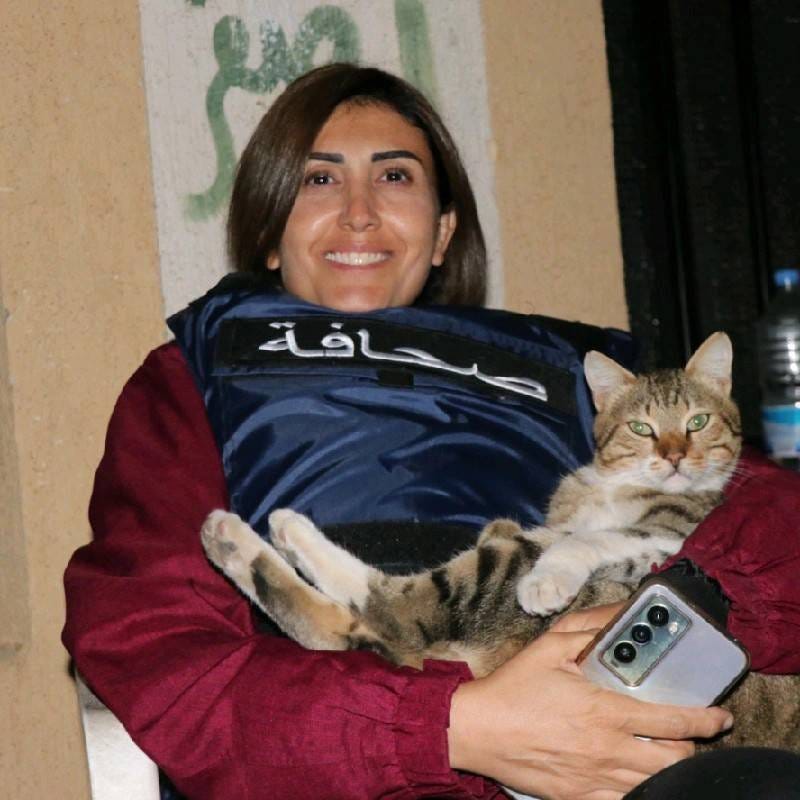
What happened to her was something from a horror film. First, the IDF blew up the car Khalil was traveling in, killing two of her colleagues. Then they shelled the house where she ran for cover, burying her in rubble. Then, in case there was any doubt about their intentions, they shot at rescue workers trying to save her. Israel denies this, of course.
Al-Akhbar is considered sympathetic to Hezbollah. Even if that were true, that does not justify hunting down a journalist Israel doesn’t like and terminating her. If the United States considers Hezbollah a terrorist organization, how can it objectively apply a different category to the military outfit literally terrorizing Lebanese journalists?
In her time in Lebanon, Bonneau has seen no evidence of Hezbollah as violent terrorists; quite the contrary, she tells me.
The group was founded by Muslim clerics in 1982, in response to Israel’s invasion of Lebanon. And there was plenty of terrorist activity in the early years, to be sure, as outlined in a pamphlet produced by the neoconservative Henry Jackson Society, “Timeline of Terror: A Concise History of Hezbollah Atrocities.” But lately? Not so much.
Even that rightwing think tank concedes (boldface mine), “The European Union refuses to place Hezbollah on its list of terrorist organisations, because doing so, it argues, would bear severe ramifications on stability in the Middle East and global security. Because Hezbollah partakes in the political process and has an active arm in the political system in Lebanon, the EU has refused to blacklist the organisation. It has further determined that there is no tangible evidence of Hezbollah’s recent engagement in terrorist activities to warrant such action.” The HJS’s own “timeline of terror” peters out after 2006.
In its updated 2009 manifesto, Hezbollah softened its hardline Islamist rhetoric. As Reuters reported at the time:
Hezbollah chief Sayyed Hassan Nasrallah, who read the new “political document” at a news conference, said it was time the group introduced pragmatic changes without dropping its commitment to an Islamist ideology tied to the clerical establishment in Iran.
“People evolve. The whole world changed over the past 24 years. Lebanon changed. The world order changed,” he said via a video link.
Stressing a history of struggle against Israel, the 32-page document said Hezbollah had to remain alert and wary of Israel: “Israel represents a constant threat and an impending danger to Lebanon.”
Nasrallah, reading from the document, said U.S. “arrogance” prevented Hezbollah and other Arabs and Muslims from forging a friendship with the United States, Israel’s chief ally.
Was Nasrallah wrong about Israel representing a danger to Lebanon? How about his accusations of U.S. arrogance?
And yet Israel has premised its invasion of Lebanon on eliminating Hezbollah as a terrorist group. Why did the IDF reduce an entire town to rubble? “It was a Hezbollah stronghold.” Why did it blow up apartment buildings? “There were Hezbollah living there.” Why does it attack hospitals? “It’s well known that Hezbollah uses medical facilities as a shield.” Even if that were true—and I’m not convinced that it is—it doesn’t justify the daily commission of war crimes of the kind Bonneau has been documenting.
Nine and a half weeks into the war, there is no denying what Israel is doing to its neighbor to the north. On Sunday, the New York Times ran a story—“Israel Said It’s Applying the Gaza Model in Lebanon. This Is What the Devastation Looks Like.”—complete with photos, videos, and before-and-after satellite images, describing the scope of the destruction in southern Lebanon:
Widespread demolitions have flattened expanses of at least two dozen towns and villages near the border, with damage to government offices as well as civilian infrastructure, including schools, hospitals and mosques.
Villages are now blurred into ash, with the white of rubble marking town after town.
Is this really a security measure? Displacing a million people, most of whom have absolutely nothing to do with Iran? Destroying their homes, annihilating their crops, killing off aid workers?
“It’s quite clear, if you study history, if you read history and you look at what’s going on now [here], as well in Gaza, it’s a land grab,” Bonneau says. “It’s a resources grab. Israel is a colonial expansionist project, and they aspire to expand into this land.”
That the “new border with the state of Lebanon” announced by the odious Bezalel Smotrich includes a portion of the Leviathon basin—the oil fields beneath the Mediterranean currently claimed by the Lebanese—is further evidence that the Israelis’ intentions are more about empire than defense.
“They tell you in the news that [Israel] needs this buffer zone, security zone,” Bonneau tells me, “but that’s not true.”

The region is no stranger to warfare. Battles bloody and vicious have been fought over the land between the River Jordan and the Mediterranean Sea since before the Late Bronze Age Collapse. The word “Palestine” derives from “Philistine,” which refers to Philistia, a five-city federation that fell to Babylon in 604 BCE. And that was hardly the first time blood was shed there. One could make the argument that the 2026 conflict between Israel and Lebanon has its origins in wars waged eight thousand years ago—well before recorded history.
Much of the current regional conflict was set in motion in 1916, when a British diplomat, Mark Sykes, and a French diplomat, François Georges-Picot, came to an agreement on how Britain and France would divvy up the vast territory held by the Ottoman Empire after they won the First World War. It would have been prudent to consult the people who lived in those places before drawing up the map and signing the agreement; Sykes-Picot was an absolute clusterfuck.
The Babylonian conquest of the Philistines, the Israelite conquest of Canaan, the Roman destruction of the Temple—all of that is, quite literally, ancient history. There are maybe four score people left on earth who were alive in 1916. The modern state of Lebanon was established in 1943, and Israel in 1948—eight decades ago. The PLO moved its headquarters from Beirut to Tunis in 1982. The United Nations adopted Resolution 1701, ending the Israel-Hezbollah War, 20 years ago, in 2006—the same year the HJS “timeline of terror” begins to peter out.
At some point the history just becomes an excuse. What’s happening right now, in 2026, is that Bibi Netanyahu and his government have invaded a sovereign nation, for no good reason—just as Vladimir Putin and the Kremlin have done in Ukraine. And just like the Russian forces in eastern Ukraine, the IDF has employed a “scorched earth” policy—the “Gaza model”—to southern Lebanon.
War crimes are happening daily in both places. Trump is dicking around with President Zelenskyy of Ukraine, denying him the aid he needs to defeat Moscow, all to please his whoremasters in the Kremlin. The Israeli atrocities in Lebanon, meanwhile, are being underwritten by the United States.
At a time of financial precariousness, of rampant inflation, of massive budget cuts to all manner of federal services, and of an impending economic disaster caused by Trump’s ill-(and Bibi-)advised war with Iran, the U.S. taxpayer is footing the bill for Gaza 2.0.
Invoking the word “Hezbollah” does not make this okay.
Above is a clip from the beginning of my April 29 interview with Courtney Bonneau, along with some of the videos she’s produced, documenting war crimes committed by Israel. You can download the full episode on Apple podcasts, or listen on Spotify:
Follow Courtney:
https://x.com/cbonneauimages
https://www.instagram.com/courtneybonneauphotography/
Her website:
https://courtneybonneau.com/
Support her work:
https://www.paypal.com/paypalme/courtneybonneau


