

Baal Bearings
Why does Iran keep showing Trump worshiping an ancient Canaanite god? And why does that same demonic deity appear in Donald's own Jesus meme?

For the last month or so, the Iranians have been releasing propaganda music videos, in which the likes of Donald Trump, Bibi Netanyahu, Pete Hegseth, and Melania—as well as the Iranians and even, in a more recent clip, the Pope—are depicted as Lego figures, over hip-hop dis-tracks that absolutely slap. They are creative, they are clever, they are catchy, and they troll “the Epstein regime” to great comic effect.
Why Legos? Because Legos are toys, and showing these powerful people as little pieces of plastic kids play with is itself a dis. It’s also a low-key insult to the American audience; Iran is saying that it takes short videos with killer beats and animated toy characters for us to pay attention. Plus: The Lego Movie and The Lego Batman Movie were executive-produced, in part, by Trump’s former treasury secretary Steve Mnuchin. Oh, and: Legos are made in Denmark. Which owns Greenland. Still. Despite all the agro posturing by Trump and JD Vance.
Here, by way of example, is the chorus from my favorite of the videos:
“Your government is run by pedophiles,” it explains, as Lego Trump chases terrified little Lego girls down a dark alley. “They ordered you to die for Israel,” and Trump waves a bloody Israeli flag atop a pile of dead U.S. service members. “They ordered you to die for Israel,” and there is Bibi, somehow looking even more villainous than IRL Bibi, waving a book that says EPSTEIN FILE, as Trump, standing at a podium, sweats.
That the Iranians have been churning out these little masterpieces should be no surprise. Iran is a nation of 93 million people, many of whom are enormously creative, all of whom are enormously oppressed. Skewering Trump and Bibi and the losers in their orbit is a wonderful way to channel all that repressed creative energy.
But there’s something odd I noticed in the videos, something that gave me pause. The rapper denounces Trump—and this is supposed to be a big insult—as a worshiper of Baal. Later in that same video, Trump and Bibi are shown bowing before a thronèd Lego Baal, depicted with horns, red eyes, a monstrous head, and cloven feet. The scene is reminiscent of the picture on the Devil tarot—but with a Star of David in place of the five-pointed Satanic star:
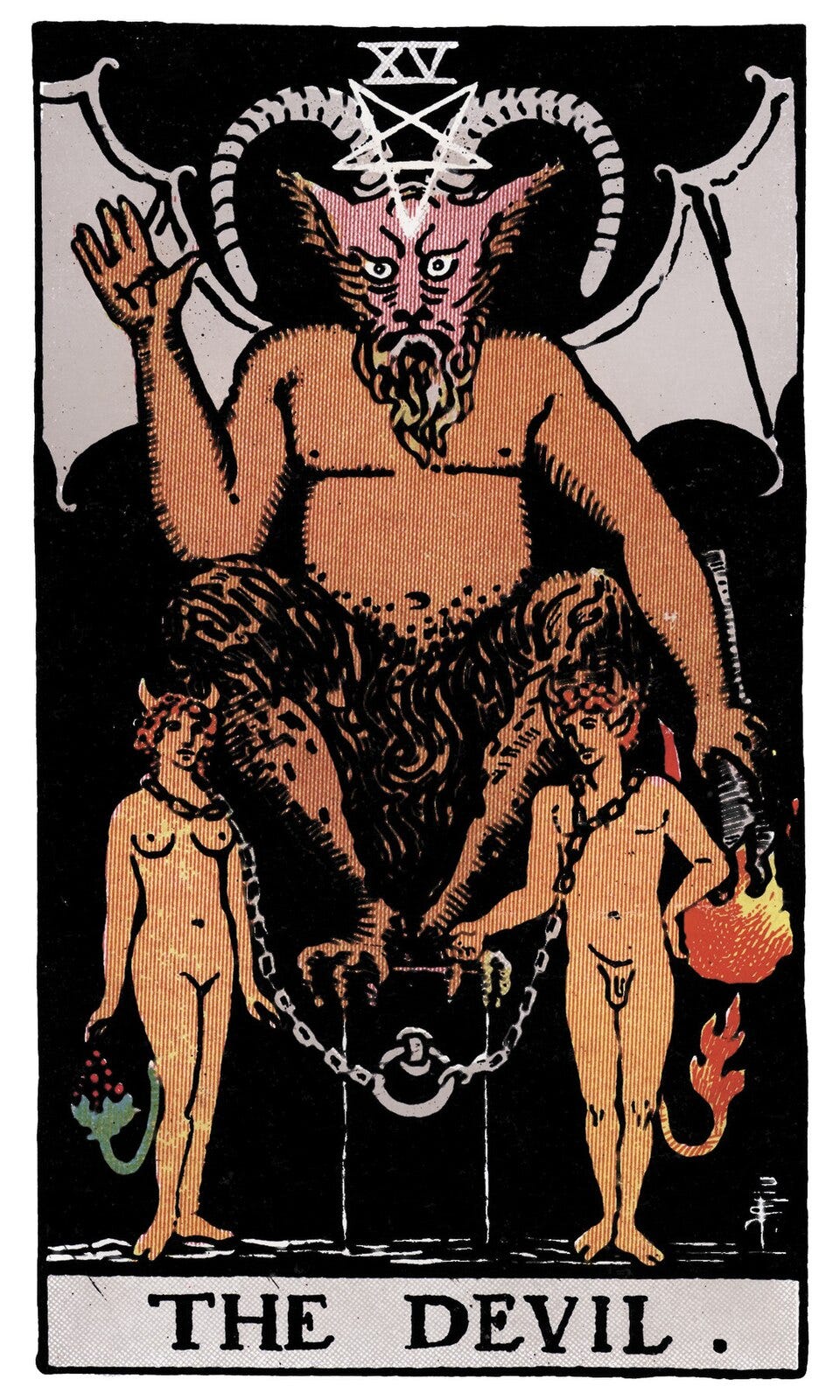
This popped out at me because, like, how many Americans know who Baal even is, let alone worship him? The Iranians, I thought, have vastly overestimated our collective knowledge of the Book of Numbers. This was probably an Ayatollah thing, a production note from the clerics. The meeting, I thought, went something like this:
CLERIC #1
Go and make these videos—but make sure there is something to indicate the blasphemy and apostasy of the Americans! Make sure Trump is shown bowing before Baal!ARTIST
With all due respect, sir, I don’t think that will land. Americans have no idea who Baal is.CLERIC #2
Show Baal, or we will behead you in the public square.ARTIST
You know what? It’s a great idea to show Baal! Excellent note, sir!
I forgot all about Baal, until a week later, when Trump released that stupid Jesus meme of him healing the sick. At the top of the image, we see this:
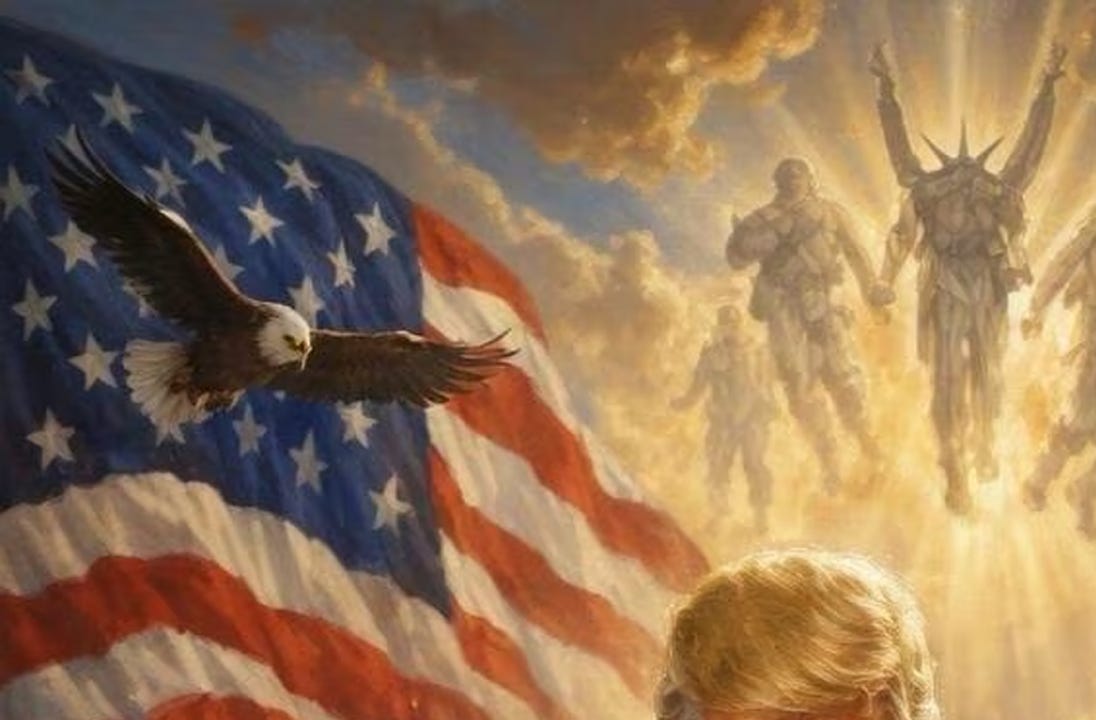
The social media consensus was that the creepy, horned guy in partial silhouette is—you guessed it—Baal.
Who, or what, is Baal? And what in the actual Hell does this all mean?
First off, Baal is not one specific deity. The word means “lord,” and was applied, four thousand years ago, to various local gods, designated by place-name, all around the Holy Land. There is even a record of Yahweh Himself being referred to as “Baal Yahweh.”
As monotheism grew—as the Hebrew God conquered and assimilated—the name became a sort of catch-all for any opposing force, any Yahweh rival. Richard Cavendish in The Black Arts tells us:
Baal means “lord,” and was a title given to many local deities in Syria and Palestine. The supreme Baal was the great fertility god of the Canaanites, whose worship involved the sacrifice of children by burning. “They have burnt also the high places of Baal, to burn their sons with fire for burnt offerings unto Baal.”
Baal is also, Cavendish explains, the seventh of the ten demons cited in the Zohar:
By the thirteenth century, the idea of ten evil sephiroth, the counterparts of the ten divine sephiroth, had developed. They are ruled by arch-demons under the supreme command of Sammael, the fell angel of poison.
The demon god appears in the Ars Goetia of the Lemegeton Clavicula Salomonis—The Lesser Key of Solomon—which dates to the seventeenth century. Baal is also one of the 69 (!) demons listed in Johann Weyer’s 1577 demonology Pseudomonarchia Daemonum; Weyer cites his source as the Liber officiorum spirituum, seu Liber dictus Empto. Salomonis, de principibus et regibus daemoniorum. (Book of the offices of spirits, or the book called 'Empto'. Solomon, concerning the princes and kings of demons.)—not the catchiest title. According to these texts, Baal has the head of either a cat or a toad—not a goat, as the Iranians have it—and has a raspy voice, not unlike RFK, Jr’s.
The eleventh and most definitive edition of the Encyclopædia Britannica (1910-11) has this to say:
The baal, as the head of each worshiping group, is the source of all the gifts of nature; as the god of fertility, all the produce of the soil is his, and his adherence bring to him their tribute of first-fruits. He is the pattern of all growth and fertility, and, by the “uncontrolled use of analogy characteristic of early thought,” the baal is the god of the productive element in its widest sense. Originating probably, in the observation of the fertilizing effect of rains and streams upon the receptive and reproductive soil, baalism becomes identical with the grossest nature-worship. Joined with the baals there are naturally found corresponding female figures known as Ashtārōth (see ASTARTE, ISTHAR). In accordance with primitive notions of analogy, which assumed that it is possible to control or aid the powers of nature by the practice of a “sympathetic magic,” the cult of the baals and Ashtārōth was characterized by gross sensuality and licentiousness. The fragmentary illusions to the cult of Baal Peor exemplify the typical species of Dionysiac orgies that prevailed. On the summit of hills and mountains flourished the cult of the givers of increase, and “under every green tree” was practiced the licentiousness, which in primitive thought was held to secure abundance of crops.
What our pre-WWI British authors are trying to tell us, as explicitly as the Edwardian censors would allow, is that, to paraphrase Dorothy Parker, the baal worshipers were very fucking busy and vice versa. This sort of devotion sounds, it must be said, a lot more fun than, say, the typical Catholic Easter mass—and certainly more appealing than adherence to the jealous, prudish, vindictive Yahweh of the pre-conquest-of-Canaan period.
The aforementioned Baal Peor was the local god of the Moabites, with whose fetching women many Israelite men, lonely and tired of wandering through the desert, hooked up with, and/or took as wives. Moses didn’t like this. Neither did Yahweh, as the Book of Numbers makes abundantly clear—because Moab women worshiped Baal Peor, and worship of Baal Peor took attention away from jealous Yahweh, and also involved a lot of open-air hanky-panky.
In a sort of ancient Hebrew Romeo and Juliet, a youth from the Tribe of Simeon made the mistake of falling in love with a Moabite girl. When he brought her back to the camp, to meet his family, one of Moses’s great-nephews took up his spear and ran it through both of the lovers—upon which cold-blooded double homicide Yahweh heaped eternal praise. Fun times!
Soon after that, the Israelites, for reasons never made entirely clear, made war on the Midianites—the closest ethnic group to Persians we get in the Book of Numbers—and wiped them off the map:
7 And they warred against the Midianites, as the Lord commanded Moses; and they slew all the males.
8 And they slew the kings of Midian besides the rest of those who were slain, namely: Evi, and Rekem, and Zur, and Hur, and Reba, five kings of Midian. Balaam also the son of Beor they slew with the sword.
9 And the children of Israel took all the women of Midian captive, and their little ones, and took the spoil of all their cattle and all their flocks and all their goods.
10 And they burned all their cities wherein they dwelt and all their goodly strongholds with fire.
11 And they took all the spoil and all the prey, both of men and of beasts.
So: bringing home your Moab girlfriend is punishable by death, but it’s totally okay to genocide an entire nation of people and take their women and children as slaves. If you ask me, Yahweh had narcissistic personality disorder. It’s curious, too, that His values seem to be simpatico with those of the modern-day Ayatollah.
But back to Baal. The Encyclopædia Brittanica tells us,
The earliest certain reaction against baalism is ascribed to the reign of Ahab, whose marriage with Jezebel gave the impulse to the introduction of a particular form of the cult. In honor of his wife’s god, the king, following the example of Solomon, erected a temple to the Tyrian baal. This, however, did not prevent him from remaining a follower of Yahweh, whose prophets he still consulted, and whose protection he cherished…
Jezebel. Huh.
We also learn that Baal was associated with Zeus, and also with Heracles.
But this passage, I think, explains why the Iranians feature Baal in the video:
Human sacrifice, the burning of incense, violent and ecstatic exercises, ceremonial acts of bowing and kissing, the preparing of sacred mystic cakes, appear among the offenses denounced by the Israelite profits, and show that the cult of Baal (and Astarte) included the characteristic features of heathen worship which recur in various parts of the Semitic world, although attached to other names.
Cavendish is more specific: Baal worship “involved the sacrifice of children by burning.”
Child sacrifice.
Blood libel.
Jews first crossed the Channel after the Norman Invasion of 1066, at the invitation of William the Conqueror. The small communities quickly prospered—because Jews offered a service essential to economic growth (lending with interest) with which Christians were ineligible to participate—establishing settlements in London and, crucially in the history of antisemitism, Norwich.
As long as things were going smoothly with regards to the economy, and the harvests were bountiful and the Vikings didn’t pillage too aggressively, Jews lived in harmony with their Christian neighbors—provided that the reigning king wasn’t a cynical, amoral asshole. Henry II, for example, was a good king to the Jews of England. But his death in 1189 sparked a wave of anti-Jewish violence, including a massacre at York in 1190.
It was at this time that the “blood libel” first appeared, in the aforementioned village of Norwich. As the ADL explains, blood libel is
a centuries-old false allegation that Jews murder Christians—especially Christian children—to use their blood for ritual purposes, such as an ingredient in the baking of Passover matzah (unleavened bread). It is also sometimes called the “ritual murder charge.”
Here’s how the rumor started: A local Norwich boy, called William, died in 1144, his body found in the woods. His mother—probably to distract from her own involvement in William’s death—blamed the local Jews. No one else did, because the woman was an obvious nutter, and life went on. Then a roving monk, Thomas of Monmouth, showed up in town and got wind of the story. He decided that William was a saint. He determined, without any actual evidence, that the Jews had indeed murdered young William. And he wrote a treatise about it. As Madeleine Schwartz explains in The Nation:1
Thomas writes that as the Jews began to celebrate Passover, they grabbed William from behind and tortured him with a fuller’s tool. They then shaved his head and pricked him with thorns in a cruel imitation of Christ’s Passion. They bound his right foot with chains and pierced his left side. When blood began to flow uncontrollably, they doused the dying boy with boiling water. Finally, after a few days, they hung the body from a tree, until passersby eventually buried it.
The roving monk’s account is, obviously, pure invention. He made it up out of whole cloth. But his work of fiction was amplified and embellished through the years, typically by anyone in authority seeking to cast aspersions on Jews.
Jews were expelled from England in 1290, after a series of laws designed to deprive their communities of income and resources. This was because, as usual, the king, Edward I this time, was in financial trouble due to mounting expenses related to the English war machine. As an Oxford University report puts it:
Kings, especially Henry III (1216-72), tried to extract large sums of money from the Jewish community as taxes and forced ‘gifts’. In order to pay these sums, Jewish lenders often sold on the debts owed to them by Christians, and the new owners of the debt pressured the debtors to pay up. As English knights became increasingly indebted, Jewish lenders got the blame. In Parliament, from the 1260s onwards, local representatives demanded measures be taken to curb Jewish lending. It is likely that these changes contributed to several thousand Jews deciding to leave England.
By 1275, Edward I decreed that Jews could no longer loan money for a living and would have to convert to being merchants, labourers or owning farmland. This statute also confirmed long-standing rules for Jews, e.g. requiring Jews to wear badges (in the shape of stone tablets) to identify them. By 1290, Edward was under pressure: having run up large debts waging war abroad, he needed to negotiate a financial settlement. But Parliament’s permission was needed before a tax would be raised. One thing Edward was willing to barter was the remaining Jewish population. In return for an Edict of Expulsion, Parliament granted Edward a tax of £116,000—the largest single tax of the Middle Ages.
When Jews lost the protection of the king, they were subject to intimidation by the local peasantry, who were typically close-minded, loyal to the king, superstitious, gullible enough to believe the “blood libel” lies, eager to blame their problems on a convenient scapegoat, and—most importantly—greatly outnumbered them.
Look at the still shot from the video again:
Baal has the Star of David on his forehead. His throne is surrounded by prayer candles and Hebrew scrolls. He’s clearly being associated with Jews. Once we discover that Baal worship involved child sacrifice, the clip becomes a subtle, almost subliminal nod to the dangerous, hateful “blood libel” false narrative.
And that is the danger here. The Iranian Lego videos are slick, entertaining, and clever, and they vent the outrage many of us feel about Trump and about Netanyahu. I am enjoying the hell out of them. But good propaganda is like that. It’s compelling, and it contains a lot of truth—to better disguise and effectuate the disinformation and falsehoods that it exists to broadcast.
An Israeli flag is a symbol of the Israeli government; but a Star of David, like the one on Baal’s forehead, is a symbol of Jewish people. It is not antisemitic to criticize Bibi, or the IDF, or Tel Aviv. It is antisemitic, dangerously so, to perpetuate the “blood libel” lie—which is what the Baal section of the video seems to be doing. This antisemitism must be identified, and it must be called out.
In joining with Bibi the Butcher to attack Iran, Trump has ceded the moral high ground to the Ayatollah—which ain’t easy to do. But that doesn’t change the fact that the Revolutionary Guard is an odious organization; that the clerics routinely slaughter the Iranian people, especially the women, who still bravely protest against the retrograde, repressive state; and that Tehran is in league with Moscow—which, whether Trump knows it or not, is our mortal enemy.
The United States has done a lot of wicked shit over the years, for sure, including to the Iranians, most notably in the 1953 coup that installed the Shah to the throne. But Iran is hardly blameless. The Ayatollah’s regime executes more of its citizens than any other country on earth, usually for “offenses” that in a civilized and free society would not be even remotely criminal, often in brutal, medieval ways. The internet is restricted, the government is corrupt, citizens cannot leave the country. It sucks. As evil and genocidal as Netanyahu’s government is, we cannot lose sight of the fact that the Ayatollah is also heinous. The Iranians1 are not the heroes here, despite how they are depicted in the Lego videos.
One last note about Baal:
Beelzebub, a fixture in demonic literature, takes his name from a truncation of “Baal” and “Zebub.” Because of his depiction as a gigantic wingèd insect, zebub is thought to mean “fly.” Thus, Beelzebub is, literally, the Lord of the Flies.
But zebub may also mean “dung beetle,” or just “dung.” Which means Donald Trump may himself be Beelzebub—the King of Shit.
TONIGHT
We are back on The Five 8, at 8pm ET:
Photo credit: Still shot from video.
Meaning, to be clear, the Iranians as in the Iranian government / the clerics.
Hi, Greg,
As always, I appreciate your scholarship and fascinating insights, particularly in this case, on the subtext of these videos, which I also find entertaining. I'm a little confused as to where you wind up at the very end, perhaps because I am trying to find implications that you may not be making about the ongoing war. It seems that the majority of Iranians are - or were, before Trump et al started bombing the shit out of them - also opposed to the regime. Is the argument: "Don't lionize the Mullahs and give in to anti-Semitism just because Trump and Netanyahu are awful?" If so, would it make sense not to use the term "the Iranians" to describe those in charge, since the rulers no more represent the people of Iran than Trump does the majority of Americans?
TGIF🎉🎉🎉One week closer! If anyone’s in the Boston area on Patriots Day, Monday, and you’re NOT running the Marathon, come over to the ICE protest at Wall Street in Burlington. Gonna be YUGE!