

Drunk on Cuba Libre
Greenland was a bust. Iran is a catastrophe. Might Trump's imperial appetites be sated a little closer to home?
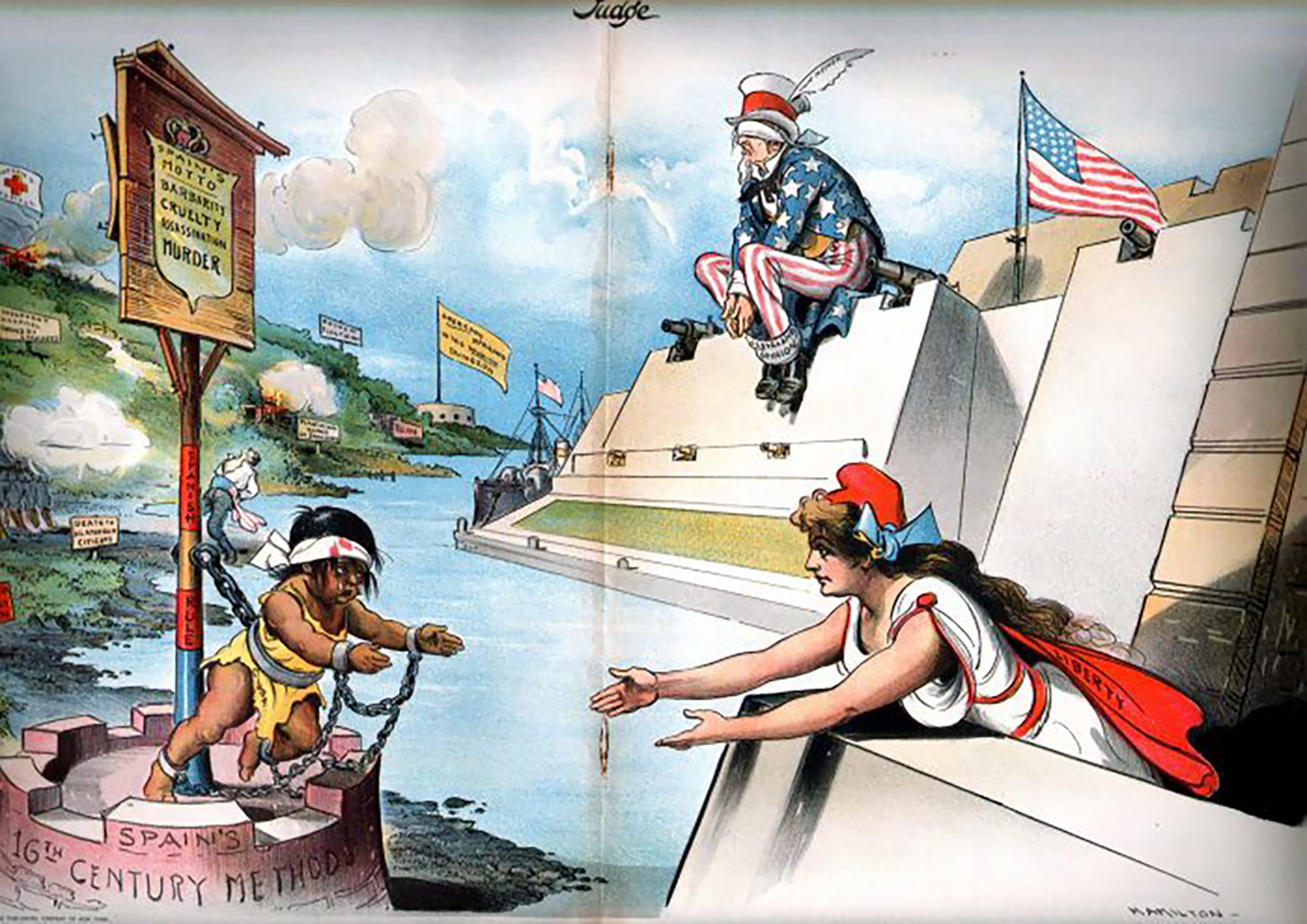
Appalled by the viciousness of the autocratic government, sympathetic to the country’s oppressed people, and desirous of spreading democracy around the globe, the United States declares war on a once-mighty but moribund empire.
Not Iran in 2026; I speak of Spain in 1898.
It is not a fair fight. The hostilities begin right around Easter and end before the first day of school; the peace treaty is signed by Christmas. There are 2,246 military deaths—2,000 from infectious disease, almost all the rest from the sinking of the Maine; the conflict does not make the list of the top ten bloodiest wars in U.S. history.
And it is wildly successful. The decaying empire falls forever. The oppressed people are liberated—albeit briefly. The United States expands its territory and even tries its own hand at colonial power.
The Spanish-American War is everything Trump wanted his “excursion” with Iran to be.
The nation’d had designs on Cuba since before the Civil War. In 1854, during the administration of James Buchanan—who for decades was considered the worst president in American history but now stands comfortably at either third or fourth worst, depending on how you feel about Andrew Johnson and George W. Bush—the so-called Ostend Manifesto proposed a decidedly Trumpian policy: the United States should offer to buy Cuba from Spain, and, if the Spanish refused, declare war and take the island by force. Ostend was widely opposed in the North—because of an aversion to empire-building, yes, but mostly because annexing Cuba was a regarded as a sneaky way of expanding slavery in the South.
Things in Cuba festered for half a century, and finally came to a head in 1898. Then as now, the Cuban government was oppressive. Valeriano Weyler, the island’s Governor-General, was nicknamed “The Butcher” due to his unsound methods of putting down a popular uprising. As the 1910-11 edition of the Encyclopedia Britannica notes:
Among the military means adopted by the Spaniards to isolate their foes were “trochas” (i.e., entrenchments, barb-wire fences, and lines of block-houses) across the narrow parts of the island, and “reconcentracion” of non-combatants in camps guarded by the Spanish forces. The latter measure produced extreme suffering and much starvation (as the reconcentrados were largely thrown upon the charity of the beggared communities in which they were huddled.)
Reconcentrados, as the name implies, were concentration camps.
The American people had sent food to the reconcentrados; President McKinley, while opposing recognition of the rebels, affirmed the possibility of intervention; Spain resented this attitude; and finally, in February 1898, the United States battleship “Maine” was blown up—by whom will probably never be known—in the harbour of Havana.
In April 1898, Washington told Spain to recall its troops from Cuba; when Spain refused, the U.S. imposed a naval blockade on the island. Four months later, the war was over. When the dust settled, Spain was eighty-sixed from North America, and the United States picked up the Spanish possessions of Puerto Rico, Guam, and the Philippines. Cuba was libre—and the U.S. promised to keep it that way.
When we consider what was gained, what was sacrificed, why the war was fought, how many Americans supported it, and how quickly the objectives were achieved, the Spanish-American War is arguably the most successful military operation in American history. It is the polar opposite of this year’s conflict with Iran, which is unnecessary, pointless, self-defeating, unpopular, economy-destroying, morally reprehensible, and humiliating in every possible way.
Frozen out by the people of Greenland and pantsed by Iran, Donald Trump is desperate for a victory to salvage his laughingstock legacy—and, more urgently, to help himself in the midterms. Has he turned his attention to Cuba, where the Spanish-American War began, in the hopes that a sequel of that 1898 conflict might prove equally successful? Because it certainly seems like he’s preparing to move on Cuba.
On January 29th, Trump issued an executive order, seemingly out of the blue, imposing an oil blockade on the island. The reason he gave is this:
The Government of Cuba has taken extraordinary actions that harm and threaten the United States. The regime aligns itself with — and provides support for — numerous hostile countries, transnational terrorist groups, and malign actors adverse to the United States, including the Government of the Russian Federation (Russia), the People’s Republic of China (PRC), the Government of Iran, Hamas, and Hezbollah. For example, Cuba blatantly hosts dangerous adversaries of the United States, inviting them to base sophisticated military and intelligence capabilities in Cuba that directly threaten the national security of the United States. Cuba hosts Russia’s largest overseas signals intelligence facility, which tries to steal sensitive national security information of the United States. Cuba continues to build deep intelligence and defense cooperation with the PRC. Cuba welcomes transnational terrorist groups, such as Hezbollah and Hamas, creating a safe environment for these malign groups so that these transnational terrorist groups can build economic, cultural, and security ties throughout the region and attempt to destabilize the Western Hemisphere, including the United States. Cuba has long provided defense, intelligence, and security assistance to adversaries in the Western Hemisphere, attempting to thwart United States and international sanctions designed to enforce the stability of the region, uphold the rule of law, and safeguard the national security and foreign policy of the United States. Cuba continues to try to thwart United States efforts to address threats to the United States posed by hostile countries, transnational terrorist groups, and malign actors, including in the Western Hemisphere.
Why the urgency? Where’s the fire? How does any of that rise to the level of an “unusual and extraordinary threat…to the national security and foreign policy of the United States?” I mean, Russian signals intelligence hubs? Give me a break. Like, the current occupant of the Oval Office is a Kremlin asset—as I’ve painstakingly detailed for years now. Hard to see how a Russian signals intelligence operation in Havana trumps Trump.

In February, as Mariana Perez of the Inter-American Law Review explains, Trump
floated the idea of a “friendly takeover” of Cuba. After a campaign event in Texas, he stated, “[t]he Cuban government is talking with us. They’re in a big deal of trouble… They have no money, they have no anything right now. But they’re talking with us and maybe we’ll have a friendly takeover of Cuba.” These remarks followed the capture of Venezuelan dictator Nicolás Maduro earlier in the year, an event that sent shockwaves throughout Latin America. The effects have been especially pronounced in Cuba, which lost access to Venezuelan oil exports.
Then, in April, the Department of Justice indicted Raúl Castro—Fidel’s brother and the former President of Cuba, who incidentally turns 95 tomorrow—and six other Cuban nationals for their alleged participation “in the Feb. 24, 1996 shoot‑down of two unarmed U.S. civilian aircraft operated by Brothers to the Rescue (BTTR), also known as Hermanos al Rescate, over international waters.”
The indictment was unsealed on May 20th. “For the first time in nearly 70 years, senior leadership of the Cuban regime has been charged in the United States for alleged acts of violence resulting in the deaths of American citizens,” said Acting Attorney General, Trump lickspittle, and Ghislaine Maxwell canoodler Todd Blanche. “President Trump and this Justice Department are committed to restoring a simple principle: if you kill Americans, we will pursue you. No matter who you are. No matter what title you hold.”
Tough talk, but the Castro indictment is nothing but a troll. Even if the allegations are true, the United States spent the beginning of 2026 using Venezuelan fishermen as target practice, and thus is in no position to take the moral high ground on extrajudicial executions in international waters.
Why is Trump doing this now?
On the first of May, in another executive order, Trump imposed sanctions on unnamed Cuban nationals who were responsible for “repression” by the Cuban government (which, to be fair, does a lot of repressing). The E.O. seems to be a precursor to some serious asset seizure:
All property and interests in property that are in the United States, that hereafter come within the United States, or that are or hereafter come within the possession or control of any United States persons of the following persons are blocked and may not be transferred, paid, exported, withdrawn, or otherwise dealt in:
(i) any foreign person determined by the Secretary of State, in consultation with the Secretary of the Treasury; or by the Secretary of the Treasury, in consultation with the Secretary of State.
About that Secretary of State: Marco Rubio’s fingerprints are all over this. His parents, as he never tires of reminding us, were born in Cuba. They came to the U.S. in the 1950s, when Cuba’s strongman Fulgencio Batista—our man in Havana—teamed up with Lucky Luciano and Meyer Lansky to make the city into a gleaming hub of gambling and prostitution. The well-heeled Cuban refugees who fled to Miami after Fidel Castro took over in 1959 were, generally, allies of the Batista regime and/or Fulgencio’s Mafia cohorts; small wonder Trump would give them a sympathetic ear (if not one disfigured in any way by gunshot wounds). Doubtless Rubio is intimately familiar with the history of the island, and fancies himself the next all-powerful Governor-General. Wouldn’t that make Mommy and Daddy proud?
Four months after the current U.S. oil embargo, Cuba has, quite literally, run out of gas. A New York Times in Spanish report from May 28th explains the peril:
As a result, daily life is becoming increasingly difficult. Electricity works for only a few hours a day, Cubans cook with charcoal and firewood, aid distribution is complicated by a lack of gas, and fuel is only available on the black market, where it can cost more than $40 a gallon.
Cubans are preparing for the summer heat, when energy demand typically increases, while the Trump administration hopes the situation will force Cuban officials to accept U.S. demands.
Because there is no fuel, sanitation trucks cannot operate, and the streets of Havana are piled high with trash.
It’s a humanitarian disaster waiting to happen.
And Trump and Rubio are intentionally exacerbating the suffering.
Previously, as Mariana Perez mentioned, Cuba got most of its oil from Venezuela—but ever since the Maduro kidnapping, the spigot has been cut off. It’s almost like Venezuela, an inexplicable undertaking in the moment, was a chessboard move whose entire purpose was to set up an attack on Cuba.
If history is not entirely on Trump and Rubio’s side, it can surely be spun to help the argument for war with Cuba. The Platt Amendment of 1901 granted the United States “the right to intervene in Cuban affairs in order to defend Cuban independence and to maintain ‘a government adequate for the protection of life, property, and individual liberty.’” Indeed, U.S. troops occupied Cuba from 1906-09, because the locals couldn’t get their shit together and govern properly. It is that same amendment—to an army appropriations bill, not to the Constitution—that allows the U.S. to maintain its lease on the military base at Guantanamo Bay.
Is the Platt Amendment still in effect? No. It was repealed by FDR. Will Trump and Rubio cite the Platt Amendment if and when they decide to regime-change the Communist government in Havana? Almost certainly. “We are bound by U.S. law to defend Cuban independence and to maintain ‘a government adequate for the protection of life, property, and individual liberty’” is a wonderfully persuasive talking point. Americans just love the idea of spreading democracy and defeating evildoers.
And then there’s the JFK piece. In the first days of the disastrous Iran war, the MAGA messaging was, “The Iranian regime has been allowed to exist for 46 years. Trump is finally doing something about it.” I’m sure we’ll hear something in the same vein, should the U.S. attack Cuba: “In 1962, JFK failed at the Bay of Pigs to overthrow the Communists. We will finish the job,” or somesuch. I wouldn’t be surprised if there is some selective release of Kennedy assassination documents that appear to implicate Fidel Castro in the 1963 hit, just to give Fox News something fresh to rile up the base with. (It would not be the first time U.S. media went crazy over war in Cuba.)
In a May 20th address, in Spanish, to the Cuban people, Rubio was clear:
The reason you are forced to survive 22 hours a day without electricity is not due to an oil “blockade” by the U.S. As you know, better than anyone, you have been suffering from blackouts for years.
The real reason you don’t have electricity, fuel, or food is because those who control your country have plundered billions of dollars, but nothing has been used to help the people.
Rubio promised “$100 million dollars in food and medicine for you, the people”—but only if—and I’m paraphrasing here—the corrupt Communist government fucks off.
“In the U.S. we are ready to open a new chapter in the relationship between our people and our countries,” he said, not unsubtly, at the end of his address. “And, currently, the only thing standing in the way of a better future are those who control your country.”
Rubio has a point. The Cuban government sucks—although 66 years of U.S. embargoes have surely not helped matters. And the Secretary of State of a regime that’s actively building its own reconcentrados cannot claim moral superiority.
Is this all just tough talk, or is the Trump Administration serious about regime change in Cuba? Is a “friendly takeover” possible? Is Rubio angling to be the new Fulgencio Batista? How soon after a changeover can Trump’s associates in organized crime reinvigorate Havana? Will Jared Kushner get to build some new hotels and casinos? Will there be Trump Tower Havana? Trump-branded cigars? A new boondoggle for Ivanka?
And: might U.S. intervention in Cuba actually be…a good thing?
All I can say for sure is that, in 2026, Trump wants to party like it’s 1898.
Photo credit: An American cartoon published in Judge, February 6, 1897: Columbia (representing the American people) reaches out to the oppressed Cuba (the caption under the chained child reads "Spain's 16th century methods") while Uncle Sam (representing the U.S. government) sits blindfolded, refusing to see the atrocities or use his guns to intervene (cartoon by Grant E. Hamilton).
Batista’s government came about because we tolerated if not encouraged his corruption and that of organized crime. The Castro brothers and Díaz Canel have allowed Cuba to sink into decrepitude. I have no use for the current government of Cuba, which is good only at one thing, and that is espionage. Cubans have to use ration coupons to purchase limited quantities of staple foods, and not all of their hardships are due to the embargo. Trump should leave Cuba alone. We should offer humanitarian aid to the ordinary Cuban people, but it would never occur to Trump to do this because he is transactional and a sociopath. The Cuban government would also be unlikely to permit such aid.
Racism still exists in Cuba, despite Fidel Castro’s claims it did not, and Trump would treat Afro Cubans with the same racism which he doles out to African Americans and others judged as “not white enough.” He also would offer no real economic aid to ordinary Cubans and would fail to repair any economic damage in Cuba. This is because he is only capable of chaos and wreckage. He is wrecking the economy for ordinary Americans, and he would enable some Miami exiles to create a new Cuban oligarchy the way he has helped to do here.
It’s TUESDAY🎉My bet is the broligarchs want Greenland so they can turn it into the world’s largest data center, and the mob wants Cuba to turn it into Isle de Vegas.🤷🏼♀️