

Sunday Pages: "Julius Caesar"
A play by William Shakespeare
Dear Reader,
On September 7, 1599, Elizabeth I, England’s “Virgin Queen,” turned 66. Exactly two weeks later, a Swiss traveler to London, the diarist Thomas Platter the Younger, took in a new play—the first documented performance of William Shakespeare’s Julius Caesar.
The two events are not unrelated.
In her book Caesar: A Life in Western Culture, Maria Wyke, Professor of Latin at University College London, posits that Shakespeare wrote the play not to delve into the bloody history of Rome, but to warn his fellow Englishmen about the potentially catastrophic effects of wars of succession. Elizabeth was the daughter, and only surviving child, of the gluttonous Henry VIII and his second wife, the ill-fated Ann Boleyn. By 1599, she’d already been queen for forty years and, unmarried and celibate, had no heirs. No one was quite sure who might take the throne next—a question that had plagued England since 1562, when she miraculously survived a severe bout with smallpox that left her disfigured (and compelled her to paint her face with her signature white makeup, to cover her scars). It is impossible that Shakespeare would not have felt the collective national anxiety concerning the looming end of his monarch’s long reign.
Julius Caesar is mostly a debate on whether the assassination of republic-destroying would-be dictators is justifiable—to kill or not to kill: that is the question. Cassius wants Caesar dead; Marc Antony wants him alive; Brutus has to decide whether to join the conspirators or the loyalists. Once the Ides of March rolls around, and the deed is done, all hell breaks loose.
By 44 BC, when the events of the play take place, the Roman Republic was already running on fumes. Sulla, a statesman and general, had established the template for dictatorship a generation earlier, after leading a coup. That Caesar would go the authoritarian route became inevitable after he led his troops across a river in the north, called the Rubicon, to march on Rome—an event so historically significant that crossing the Rubicon still, to this day, two millennia and change later, means passing the point of no return. “Let the die be cast,” he is reported to have said, before proceeding.
As the drama unfolds, Cassius, steadfast in his desire to off the budding tyrant, simply refuses to kiss the ring. His ego is too big, his personal animus too great. In his attempt to recruit Brutus to the conspiracy, he says,
I know that virtue to be in you, Brutus,
As well as I do know your outward favor.
Well, honor is the subject of my story.
I cannot tell what you and other men
Think of this life; but, for my single self,
I had as [well] not be as live to be
In awe of such a thing as I myself.
I was born free as Caesar; so were you;
We both have fed as well, and we can both
Endure the winter’s cold as well as he.
In other, more modern words: “Fuck that noise, I’d rather die than bow down to this guy.” Then he regales Brutus with tales of Caesar’s lily-livered weakness—and, therefore, his singular unsuitability to kingship. First, Cassius recalls the time he saved the supposedly godly Caesar from drowning:
For once, upon a raw and gusty day,
The troubled Tiber chafing with her shores,
Caesar said to me, Dar’st thou, Cassius, now
Leap in with me into this angry flood
And swim to yonder point? Upon the word,
Accoutered as I was, I plungèd in
And bade him follow; so indeed he did.
The torrent roared, and we did buffet it
With lusty sinews, throwing it aside
And stemming it with hearts of controversy.
But ere we could arrive the point proposed,
Caesar cried, Help me, Cassius, or I sink!
I, as Aeneas, our great ancestor,
Did from the flames of Troy upon his shoulder
The old Anchises bear, so from the waves of Tiber
Did I the tired Caesar. And this man
Is now become a god, and Cassius is
A wretched creature and must bend his body
If Caesar carelessly but nod on him.
And then he mocks Caesar for being an unmanly wuss when he was taken ill:
He had a fever when he was in Spain,
And when the fit was on him, I did mark
How he did shake. ’Tis true, this god did shake.
His coward lips did from their color fly,
And that same eye whose bend doth awe the world
Did lose his luster. I did hear him groan.
Ay, and that tongue of his that bade the Romans
Mark him and write his speeches in their books,
“Alas,” it cried “Give me some drink, Titinius”
As a sick girl.
Cassius ends his plea by shaking his head in bemused wonderment, baffled that this idiot, of all people, is the one who was going to be made Emperor. How could it be, that of the millions of available Romans in the vast dominions, it’s this cowardly schmuck who ends the Republic and gains the throne? (Sounds familiar, huh?)
You gods, it doth amaze me
A man of such a feeble temper should
So get the start of the majestic world
And bear the palm alone.
Like, seriously, Cassius is saying: WTF?
For Brutus, Caesar’s close friend, the issue isn’t personal but political. He is a staunch believer in the Republic. And while he knows Caesar will probably be chill about the whole king thing, he also recognizes that, as Lord Acton would remark many centuries hence, absolute power corrupts absolutely. There is no telling what his chum might do, once elevated to dictator. And there is no question that Caesar will be so elevated, and soon. That is his “ambition,” a word Shakespeare uses time and again in the script. The only way to stop Caesar from taking down the Republic, Brutus soliloquizes, is to terminate him now, while there is still a chance:
It must be by his death. And for my part
I know no personal cause to spurn at him,
But for the general. He would be crowned:
How that might change his nature, there’s the question.
It is the bright day that brings forth the adder,
And that craves wary walking. Crown him that,
And then I grant we put a sting in him
That at his will he may do danger with.
Caesar is potentially a venomous snake ready to bite. Once elevated to dictator—to a position of “greatness”—he risks the addictive high of raw power overwhelming any inkling of restraint:
Th’ abuse of greatness is when it disjoins
Remorse from power.
Even though his friend Julius is playing it cool ATM, the rarified air he’s about to breathe will almost certainly change him for the worse:
And, to speak truth of Caesar,
I have not known when his affections swayed
More than his reason. But ’tis a common proof
That lowliness is young ambition’s ladder,
Whereto the climber-upward turns his face;
But, when he once attains the upmost round,
He then unto the ladder turns his back,
Looks in the clouds, scorning the base degrees
By which he did ascend. So Caesar may.
The way to stop this (Caesar’s inevitable transformation to tyrant) from happening is to stop this (his oh-so-evitable ascension to tyrant) from happening.
Then, lest he may, prevent. And since the quarrel
Will bear no color for the thing he is,
Fashion it thus: that what he is, augmented,
Would run to these and these extremities.
Nip the thorny rose of despotism in the bud, so to speak; go back in time and kill baby Hitler:
And therefore think him as a serpent’s egg,
Which, hatched, would, as his kind, grow mischievous,
And kill him in the shell.
And so does Brutus join the conspiracy.
The sun rises on the much-beware’d Ides of March. After Cassius, Brutus, and the others stab Caesar in the back, kill him dead, and bathe their hands in his blood as a symbol, they shout out:
CINNA
Liberty! Freedom! Tyranny is dead!
Run hence, proclaim, cry it about the streets.
CASSIUS
Some to the common pulpits and cry out
“Liberty, freedom, and enfranchisement.”
BRUTUS
People and Senators, be not affrighted.
Fly not; stand still. Ambition’s debt is paid.
While it’s obviously bad form to literally stab your friend in the back while he’s completely defenseless and unawares, Cassius, Cinna, and Brutus did so to end the threat to democracy (“enfranchisement”).
The common people are not convinced. They kind of liked Caesar, and they’re not sure what to make of this unexpected (except by all the bad omens concerning the Ides of March) turn of events. So Brutus, a noted orator, addresses the mob:
“Romans, countrymen, and lovers, hear me for my cause, and be silent that you may hear,” he says. “Believe me for mine honor, and have respect to mine honor that you may believe. Censure me in your wisdom, and awake your senses that you may the better judge. If there be any in this assembly, any dear friend of Caesar’s, to him I say that Brutus’s love to Caesar was no less than his.”
Then he gets to the heart of the matter: “If then that friend demand why Brutus rose against Caesar, this is my answer: not that I loved Caesar less, but that I loved Rome more.” Boom! “Had you rather Caesar were living, and die all slaves, than that Caesar were dead, to live all freemen?”
He separates his personal feelings about the man he’s just killed from his more altruistic reasons for participating in the murder: “As Caesar loved me, I weep for him,” Brutus explains. “As he was fortunate, I rejoice at it. As he was valiant, I honor him. But, as he was ambitious, I slew him.”
Brutus continues: “There is tears for his love, joy for his fortune, honor for his valor, and death for his ambition,” that is, for his angling for absolute power. “Who is here so base that would be a bondman? If any, speak, for him have I offended. Who is here so rude that would not be a Roman? If any, speak, for him have I offended. Who is here so vile that will not love his country? If any, speak, for him have I offended. I pause for a reply.”
The crowd is thus won over—and why? Because Brutus is correct in his assessment.
Caesar’s obvious “ambition” was to be a dictator, like Sulla before him, but on a far grander scale. Already had he begun to consolidate his power. Already had he “crossed the Rubicon” and marched on Rome. “Let the die be cast,” he said, taking that final step—thus indicating that Caesar was well aware of the stakes of the decision he was making: he would either take the throne or die trying. This forced Brutus to have to make his own choice: he could either risk his own life to save the Republic, or submit to the dictator.
Enter Marc Antony. Like Brutus, he’d been a friend to Caesar. And so Brutus, against the advice of the other conspirators, allows him to speak at the funeral. Antony’s oration is the play’s best-known monologue:
Friends, Romans, countrymen, lend me your ears.
I come to bury Caesar, not to praise him.
The evil that men do lives after them;
The good is oft interrèd with their bones.
So let it be with Caesar. The noble Brutus
Hath told you Caesar was ambitious.
If it were so, it was a grievous fault,
And grievously hath Caesar answered it.
Here, under leave of Brutus and the rest
(For Brutus is an honorable man;
So are they all, all honorable men),
Come I to speak in Caesar’s funeral.
He was my friend, faithful and just to me,
But Brutus says he was ambitious,
And Brutus is an honorable man.
He hath brought many captives home to Rome,
Whose ransoms did the general coffers fill.
Did this in Caesar seem ambitious?
When that the poor have cried, Caesar hath wept;
Ambition should be made of sterner stuff.
Yet Brutus says he was ambitious,
And Brutus is an honorable man.
You all did see that on the Lupercal
I thrice presented him a kingly crown,
Which he did thrice refuse. Was this ambition?
Yet Brutus says he was ambitious,
And sure he is an honorable man.
I speak not to disprove what Brutus spoke,
But here I am to speak what I do know.
You all did love him once, not without cause.
What cause withholds you, then, to mourn for him?—
O judgment, thou art fled to brutish beasts,
And men have lost their reason!—Bear with me;
My heart is in the coffin there with Caesar,
And I must pause till it come back to me.
As a piece of oratory, this is chef’s-kiss genius. With each repetition of “Brutus is an honorable man,” it becomes clearer that Antony means the opposite. Sure, he’s saying, Brutus says that Caesar was ambitious, but where is the proof of concept? And then he rattles off examples of Caesar acting like an average Julius, behaving most un-ambitiously. The cherry on the rhetorical sundae is at the end of the speech; note how “brutish,” as a modifier for “beasts,” sounds, quite intentionally, like “Brutus.”
The problem is, it’s not a solid argument—not really. “Caesar was a stand-up guy before he became a dictator” does not necessarily mean that Caesar would remain a stand-up guy after becoming a dictator. There’s no way to know other than to let it happen—to pass the Enabling Act and hope for the best. While Antony lets his personal affection for Caesar cloud his judgment, Brutus—quite sensibly, under the circumstances—is not willing to take that risk.
Even so, Marc Antony’s oration has the desired effect. The Roman hoi polloi—easily swayed by compelling micro-targeted narratives, even in the days before AM radio and Fox News and Facebook; filled with grievance and anger; and susceptible to calls for stochastic terrorism—turn on the conspirators. Looking for a man named Cinna, they find a man named Cinna, and they tear Cinna limb from limb. Unfortunately, it’s a different Cinna than the Cinna who helped kill Caesar; this Cinna is a poet. No matter. They kill him anyway.
And then competing armies clash, and Brutus winds up killing himself, and the Republic collapses regardless. Rome avoids becoming a Julius Caesar dictatorship by becoming a Caesar Augustus empire.
Shakespeare’s purpose in writing Julius Caesar in 1599, as Maria Wyke suggests, was to show how bloody and chaotic and terrible things can get during periods of political uncertainty. He did not want England to succumb to civil war when Elizabeth died—which she wound up doing four years later. Thus the play was informed by historical context.
But context changes.
On Armistice Day, 1937, a young Orson Welles opened the new Mercury Theater with Caesar, an adaptation that set the Shakespeare drama in contemporary Europe during the rise of Mussolini, Franco, and Hitler. Caesar was dressed like a Nazi Obergruppenführer—or, if you prefer, like the Death Star commander in Star Wars. The stage was spare and dark, with the lighting designed to evoke the “Cathedral of Light” at the Nuremberg Rallies. The climax of the play is when Cinna the poet is killed—not by an angry mob, but by state secret police: the Schutzstaffel.
Today, the look of the play is unnerving if not bone-chilling:
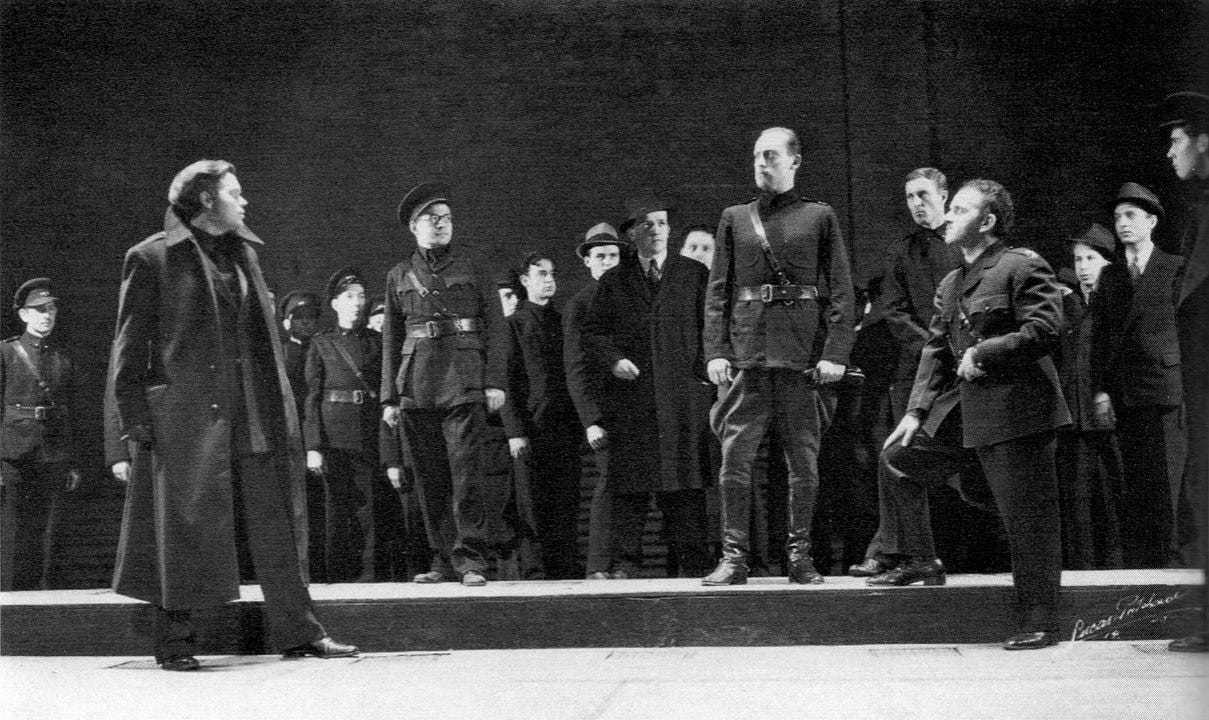
This was intended to be provocative, and it was. Caesar was staunchly and clearly an anti-fascist production, “so vigorous, so contemporary that it set Broadway on its ear,” as Welles’s friend Joseph Cotton later recalled. It hit, and it hit hard. “It would have been a fascinating experiment even if it had failed,” one reviewer wrote. “That it succeeds so admirably is enough to blow the hinges off the dictionary.”
But that was in the late 1930s, when, notwithstanding the nascent German American Bund, the fascism was safely across the Atlantic, and the theatergoing public—to say nothing of the federal government—did not side with the Nazis.
By 2017, the national mood had shifted. That summer, a Shakespeare in the Park production of Julius Caesar, staged by the Public Theater, dressed its titular would-be dictator in a blue suit, a red tie, and a yellow pompadour. The Central Park audiences loved it. But MAGA lost its shit, as MAGA will do when critical thinking is required. In an eerie foreshadowing of the corporate pusillanimity we’re now seeing in the Trump Redux, two of the organization’s sponsors, Bank of America and Delta Airlines, bowing to pressure from artless rubes, withdrew financial support for the show.
Peter Marks, then the Washington Post drama critic, calls bullshit on the MAGA outrage:
“Now hold on a darn minute,” I hear some of you saying. “You’re telling me that a character resembling Donald Trump is fake-stabbed to death in a 400-year-old piece of fictionalized history by costumed people trained in the art of make-believe? Someone call out the National Guard!”
The production, he reports, is quite good—and the message suitably ominous:
Some of the lampooning of the Trump administration is indeed fun: Caesar’s supermodel wife, Calpurnia (Tina Benko), speaks in what sounds like a Slovenian accent and dismissively bats away her husband’s hand, and Octavius (Robert Gilbert) appears on the battlefield in a blazer covered by a bulletproof vest, a la those much-derided photos of Jared Kushner in Iraq. (The scene in which Calpurnia attempts to prevent Caesar from meeting his cruel destiny occurs cheekily in their high-end bathtub.) But what feels first-rate here is not so much these editorial-cartoon interludes as the potent handling of the drama’s tragic dimension—for the sensational murder of Caesar, as orchestrated by Brutus (Corey Stoll) and Cassius (John Douglas Thompson), doesn’t free the Republic from the grips of a tyrant.
Rather, as the production makes so abundantly clear—in part by turning Brutus and Cassius’s followers into an Occupy Wall Street-style brigade of overmatched protesters—the revolution fails, paving the way for the re-installment of autocratic rule.
As the play’s director, Oskar Eustis, told Marks, “The fundamental question in Julius Caesar is what do you do to protect a democracy when a demagogue is threatening the thing that you love.”
What, indeed.
One wonders how a MAGAfied production of Julius Caesar would be staged today. Would Marc Antony be imagined as a smug weirdo with a strange accent in a baseball cap, a chainsaw, and a TECH SUPPORT t-shirt? Or would the title character be dressed that way, perhaps with a small child on his shoulders? There would be, I think, no shortage of actors and directors jumping at the chance to be involved—but I suspect corporations would not exactly line up to sponsor the project. Already the oppressive winds emanating from the White House are chilling. If there’s anything that would beg a full-scale crackdown on free speech and artistic expression from the Trump regime, it’s Julius Caes-ar-a-Lago.
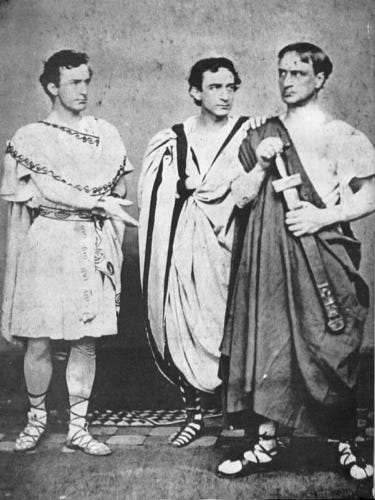
Neither the Orson Welles adaptation nor the Public Theater’s 2017 Shakespeare in the Park are the most notable American production of Julius Caesar. On November 25, 1864, at New York’s Winter Garden Theater, a one-night-only benefit performance of the play was given, to raise money for a statue of Shakespeare that still stands in Central Park. The three lead roles were played by brothers from the country’s most famous theatrical family. Edwin Booth, the Alec of these Baldwins of the Nineteenth Century, played Brutus. His older brother, the appropriately named Junius Brutus Booth, Jr., was Cassius. And playing the role of Marc Antony, ironically as it turned out, was the youngest Booth brother, John Wilkes. (That’s the three Booth brothers in the photo at the top of the page; John is at left.)
No doubt John Wilkes Booth excelled in his performance, delivering the famous funeral oration with aplomb. But however soaring his oratory, he didn’t take the words to heart. The flowery monologue he committed to memory—a speech intended to condemn assassins!—was not enough to sway him. Just five months after that performance at the Winter Garden Theater, he shot and killed Abraham Lincoln.
The United States is not fated to fall into dictatorship, any more than the Roman Republic was, or England after the death of Elizabeth I. In democracies like ours, we are masters of our own destiny. There are peaceful, nonviolent ways of saving the country, and we must try them. And if we don’t—if the fascists prevail here; if we shitcan 248 years of a government of the people, by the people, and for the people; if the jackboots come and stomp on the wrong Cinna, day after day after day; if we all of us wind up underlings of a venal Red Caesar—the fault won’t be in the stars, but in ourselves.
ICYMI
Our guest on The Five 8 was the Russian disinformation expert Molly McKew:
Sing it from the mountaintops:
Loved this one! The parallels you draw between Caesar’s time and today’s political circus are razor-sharp. History may not repeat, but it sure does rhyme—and you capture that brilliantly. Always a great read!
Wow. What a great Sunday Pages.... Thank you, Greg!
Julius Caes-ar-a-Lago
What indeed...