

Sunday Pages: "Lost Paradise"
A poem by Jaroslav Seifert
Dear Reader,
I have been to Prague only once, in 1998. That’s when I revisited the Czech capital, once one of the largest cities in Europe, for the first time.
Before I unwind that paradox, and tell of what happened to me there, and what I learned about myself by traveling there, I should explain that I’ve always felt an attraction, a kinship, almost a yearning, for Prague. And so this weekend, as I sit in Orlando, Florida—a city I feel little attraction to, not much kinship with, and zero yearning for—I find myself drawn intuitively, instinctually, as if guided by spiritual forces I cannot understand, to the medieval city on the Vltava where, four full centuries ago, a war that raged for three decades, killed a third of the population of Germany, and concluded in a Peace that established a Westphalian Order that would prevail over international relations until Putin’s invasion of Ukraine, began with two Catholic regents and their secretary being unceremoniously tossed out of a third floor window.
What’s happening right now in the United States is, first, an ominous rise of fascism, and neo-Nazi fascism specifically; second, a speedy establishment of a state secret police, with all attendant horrors, to support the encroaching fascist regime; and finally, to cap it off, an explosion—some might say an infestation—of generative AI, a brave new world of dark Silicon Valley wizardry we are ill equipped to process.
Plenty of European cities fell prey to fascism in the 1930s and 40s, or were invaded or annexed by Nazi Germany before and during the Second World War. But both of those things and the blossoming of hyper-intelligent robot tech?
Prague, and only Prague, can supply all three.
Prague, 1998.1
June in the Czech capital. Not yet summer, but hot: twenty-nine whopping degrees, according to the blinking sign outside the bank. Even if you know that twenty-nine degrees Celsius is eighty-four degrees Fahrenheit—and I don’t; metric conversion has never been my forte—the temperature reading alone doesn’t capture the heat’s oppressive grandeur, because it doesn’t factor in the malarial humidity, or the fact that I’ve been walking around for hours and have yet to hit a patch of shade. I feel like I’m in one of those cartoons where a thundercloud is following me around, raining only on me, except that instead of a thundercloud overhead, it’s the baking kiln-hot sun.
The heat is only one of the day’s obstacles. We arrived in Prague less than two days ago, so I’m still jet-lagged. My last meal was a crude goulash made from what tasted like paprika and horse meat, and that was over twenty-four hours ago. I’m so hungry I could eat…not a horse—I already tried that—but something really big.
So I’m hot, I’m jet-lagged, I’m hungry, and, oh yeah, I’m hungover. Not just hungover. Suffering through one of the worst hangovers of all time, a hangover that belongs in the Book of Lists, if not the Guinness Book of World Records. This is what happens when the local beer is the best you’ve ever consumed, and it costs eighteen cents a half-litre, and you drink it in lieu of dinner, and after your tenth or eleventh refill, you decide to fortify it with absinthe—which isn’t really absinthe but a syrupy green licorice liqueur that looks like and tastes like and for all you know is NyQuil, and is only sold to hapless expats at touristy bars like Chapeau Rouge—and you stay at Chapeau Rouge till it closes at four in the morning, and the whole evening, including the cab back to your room, costs less than ten dollars. Prague is the sort of place where you can buy a drink for everyone in the bar without taking out a second mortgage. Or breaking a twenty. My friend Chris, who’d matched me beer for beer and shot for shot, is so hungover he couldn’t even get out of bed this morning. That I am able to function at all is a testament to the quality of the liquid gold the Czechs call pivo.
So I’m hot, I’m jet-lagged, I’m hungry, I’m hungover, and, if that’s not enough, I’m lost. Calibrated to the neat New York grid system, my inner compass is completely useless on the tortuous byways of Prague. The urban planning here seems to have involved paving the paths of meandering cattle. The Staré Město, in particular, is a veritable maze. With a decent map and a good night’s sleep, I might have a fighting chance. But in the dark days before GPS and iPhones, my map sucks. And, as discussed, I’m hungover, hungry, jet-lagged, and hot, and I slept for maybe four hours last night. Plus, I’m carting around a bottle of wine, which, in my current condition, may as well be a bowling ball.
The wine is a gift for the AP’s Prague correspondent, who was good enough to find me inexpensive yet comfortable accommodations—a sort of pre-AirBnB AirBnb—and whom I wish to thank in person. The AP’s Prague correspondent is not expecting me to call, and had said correspondent been Pablo Gorondi or Dusan Stojanovic—our men in Budapest and Belgrade, respectively—I would probably be back in the hotel with Chris, sleeping it off. But I feel compelled to visit the bureau of our mutual employer, and not just as a show of courtesy. See, in addition to being hot, jet-lagged, hungry, hungover, and lost, I’m also a single red-blooded American male, and the AP’s Prague correspondent is named Nadja Rybanova.
I mean, Nadja Rybanova! I spent most of the flight over manufacturing a crush on her, even though I don’t know what she looks like, how old she is, if she’s married, or, for that matter, if she prefers the company of men. All I know is her name—but that’s enough. Nadja Rybanova is either James Bond’s love interest or Anna Kournikova’s doubles partner. Either way, she’s hot. If you have a once-in-a-lifetime opportunity to present Nadja Rybanova with a bottle of wine and ask her to dinner, you have to seize it, hangover be damned. Who knows? She might be up for a no-strings-attached liaison with a 25-year-old American aspiring-novelist-cum-benefits-coordinator.
To present the bottle of wine to the AP correspondent, of course, I must first locate the AP bureau. This is easier said than done, as I am, at the moment, walking through an urban, Czech Blair Witch Project. The bureau is on Národní. According to my map, Národní is a major thoroughfare, or as major a thoroughfare as you can find in the Staré Město: a wide, straight road extending from the metro station at Můstek, past the National Theatre to the Most Legií, which is, according to my un-trusty map, a bridge. Unfortunately, what appears straight on paper is, in actuality, anything but.
I began at Můstek, so I was able to locate that. After walking around for forty minutes, I stumbled upon the bridge. I didn’t find the National Theatre, which is supposed to be visible from the Most Legií, and if I couldn’t find the biggest performing arts center in the Czech Republic, I certainly didn’t spot the unassuming AP bureau. How can I walk from one end of Národní to the other, three times, and miss it? It’s like starting at the Williamsburg Bridge and not being able to find Delancey.
I’ve long since abandoned my map and am carrying only the bottle of wine when an insanely tall blonde dude approaches me. He looks like one of the lesser bad guys from Die Hard, except he’s wearing sandals. Birkenstocks don’t exactly inspire menace. “Excuse me,” he says. “Do you know where is metro station?”
This is the third time someone has stopped me on the street to ask for directions since we arrived. It’s like they’re seeking me out. Do I really look like I know my way around, or is everyone else even more clueless than I am? Ironically, I am able to tell him where the metro station is; Můstek is the only place whose location I know. He thanks me and bounds away, on legs as tall as my entire body.
Watching him go, I spot, on a nondescript Soviet-looking concrete building, among a bevy of Slavic signs, a small plaque bearing the familiar burnt-orange interlocking A and P that is the logo of my employer.
“Hallelujah,” I say out loud.
With renewed vigor, I make for the building. Once inside, I see that the bureau is on the sixth floor, Suite 604. There does not appear to be an elevator. Just what a hot, jet-lagged, hungry, hungover guy needs—six flights of stairs.
The sixth floor—which is actually the seventh floor, because what Europeans call the first floor is really the second floor; such are the wonders of the metric system—appears to be residential. There is nothing that indicates any business is transacted here. No AP logo, no sound of teletype machines, nothing. Weird. But I hit the buzzer for Suite 604.
The door opens to reveal a cute, voluptuous brunette, her hair wavy and short. Sparkling hazel eyes twinkle at me. The only drawback, and it is glaring, is that there are two small children clinging to her like koalas, one on her calf, the other on her hip. Nothing, not even a ring with a diamond the size of Gibraltar, says UNAVAILABLE more unequivocally than a pair of clingy toddlers. Swallowing my disappointment, I give her the happiest smile I can muster in my current condition.
“Hi. Um…are you Nadja?”
Her English is fair to middling, but she manages to convey that a) she is Nadja’s sister, not Nadja; b) this is Nadja’s apartment and not her place of business; and c) to get to the AP bureau, I need to go back down to the ground floor, follow a long hallway to the other side of the building, and then climb up a different but equally steep set of stairs to the sixth, or rather the seventh, floor. I’m not thrilled about the walking, but that’s the only thing. Not only is Nadja presumably unencumbered by two small children, but the chances of her being as beautiful as the mental picture I’ve invented of her have actually gone up. In the patois of Las Vegas, the line has moved. My buzz safely restored, I thank Nadja’s sister and go.
George Orwell gets enormous credit, and rightly so, for correctly seeing through the bullshit of Stalinist Communism, while opposing with every fiber of his being the tyranny of fascism. But he wasn’t the only European writer who did saw the truth about both evils.
Jaroslav Seifert, the great Czech poet born in the first year of the 20th Century, and who won the Nobel Prize in the 84th, also saw, also recognized, also knew. He quit the Czech Communist Party when he realized, long before most, that anything attached to the Soviet Union was not Marxist paradise but Stalinist front. He called out Stalin’s purges of the 1930s—the show trials, the executions—as they were happening.
While many writers and artists, as well as correspondents for the New York Times, whitewashed the horrors befalling Russia at the time, Seifert was not shy in his denunciations. He wrote this poem, “The Moscow Trials,” in the middle of that tumultuous decade—but other than the anachronistic word “newspapers,” he might as well be writing about the United States in the Trump Redux:
What you can read in the newspapers
Is a play, not to be believed,
And the scenes, from which come horror, dread,
Are whispered from the prompter’s box.What you can read in the newspapers
Is a play: Let the world amuse itself.
Only the ending, the smell of human blood,
Is—unfortunately, however—genuine.
Seifert was born in a suburb of Prague, grew up in Prague, made a name for himself in Prague, did not flee Prague during the war or after, when the city was transferred from Hitler to Stalin.
Prague, 1998.
Not counting a two-night stay in London in 1996, this is my first trip to Europe. Other than that quick tour, a long weekend in Montreal, and a spring break in the Virgin Islands, it’s my first trip outside the continental United States. Oh, I’ve had opportunities. I could have gone to Paris with my high school French class. I could have spent my junior year of college abroad, instead of in New York. Can’t ask Mom and Dad; too expensive—that was my excuse for not going both times. But really, I was afraid to leave my comfort zone.
But I’m an adult now, with a steady paycheck and a yen for life experience, and I decided two months ago that I needed to get my feet wet, so to speak, with Old World water, phobias be damned. Logic would have sent me again to England, because there is no language barrier; France, because I speak un peu French; or Italy, because I am fully half Italian. Plus, England, France and Italy are the obvious places for a young writer to visit, just like New York is the obvious place for a young writer to live. But none of those destinations piqued my fancy, probably because they were so obvious. Conversely, I rejected Bucharest and Krakow and Warsaw as too alien. My college roommate, Jeff, had backpacked fearlessly across Europe in ’95…until he hit Poland, whereupon the lugubrious post-Communist strangeness gave him pause. A country that spooked my well-traveled friend was sure to terrify me. What I wanted was someplace foreign but familiar, not too obvious but not too strange, a combination of East and West. What I wanted was Prague.
The Czech metropolis was an unusual choice for a maiden voyage to the Continent, but in 1998, it wasn’t that unusual. The so-called Velvet Revolution of 1989 had opened the doors of what was still Czechoslovakia, and with a bang. Prague became an obligatory destination for aspiring men of letters. That the city of Kundera, Kafka, and Klima had selected a playwright, Václav Havel, as its president only enhanced its literary cachet. Expatriates of a writerly bent flocked to Prague to soak up its vibrancy, its novelty, and, yes, its astoundingly cheap and delicious pivo.
I mean, if you wanted to be a Bohemian, where better to decamp than the capital of Bohemia?
Not that I was a true Bohemian. Or even a convincing fake one. Bohemian enclaves are known for cheapness and grit. Paris between the wars, Greenwich Village a generation before. Prague? Maybe in the early 90s, in its hipster heyday. By ’98, the bubble had burst. It was still cheap, but hardly gritty.
So: beer, life experience, aspirations literary and hipster. Good enough reasons to go where I did—but post hoc ergo propter hoc rationalizations, all. I chose Prague over Paris, Rome, London, Budapest, Moscow, and Athens—and, for that matter, Tokyo, Cairo, Hong Kong, Jerusalem, Rio de Janiero, and Havana—because, quite simply, I felt like going there. Prague appealed to me, in the same way that the Yankees appeal to some people, the Mets to others. There was no logic to it. It can’t really be explained, any more than you can explain my mother’s love of the color yellow, or my friend Chris’s disdain for Led Zeppelin. I prefer Milton to Shakespeare, Bach to Mozart, Dalton to Brosnan. How come? Nature? Nurture? Or something else entirely?
Prague called out to me. And here I am.
One of the few Czech words to break into the English lexicon is robot. It is a coinage of another Prague resident, the novelist and playwright Karel Čapek, ten years older than Seifert, who introduced the now-ubiquitous word in his 1920 play “R.U.R.,” or “Rossum’s Universal Robots.” In his conception, a robot is a cylon or a replicant—an imitation human made from “synthetic organic” material—and not like a machine that assembles cars, or even a Star Wars droid.
The plot involves a representative from the League of Humanity, Helena, who seeks to liberate the robots from their bondage. Robots, she argues, have souls. In time, the birth rates decline, the robot population skyrockets, and robots are on the verge of taking over the world. Eventually all the humans are exterminated except for one, who the robots keep alive to discover the Missing Ingredient to making a robot, which formula Helena had burned.
Čapek—or actually, according to Čapek, his brother and closest friend, the artist Josef Čapek—came up with the word. But the concept dates to a much earlier period in Prague’s history—340 years prior to the release of “R.U.R.”, to be exact.
In the year 1580, Rabbi Judah Loew ben Bezalel, the Talmudic scholar and Jewish mystic known as the Maharal, became aware of an existential threat to the Jewish community of Prague. A villainous priest demanded their extermination, inciting a pogrom. So, the legend goes, the Maharal constructed a “Golem”—a giant warrior, built of clay dredged from the River Vltava, and brought to life by the ritual invocation of the Shem Hameforash—the True Name of God. It worked: The Golem repulsed the gathering mob and slew the priest, ending, for the time being at least, the persecution of the Prague Jews. The Maharal returned the Golem to clay, storing the inanimate remains in the attic of the synagogue, in case its protection was ever needed again.
(If this sounds vaguely familiar, even though you’re not typically down with Jewish folklore, it may be because Michael Chabon writes about the Golem in his 2001 Pulitzer Prize-winning novel, The Amazing Adventures of Kavalier and Clay.)
Like Seifert, Čapek was a staunch and outspoken anti-fascist—so much so that when the Gestapo took control of the country, after the Nazi seizure of the Sudetenland was met with craven appeasement by the Allies, he was considered “Public Enemy #2.”
Čapek managed to evade the Nazis—but not in the way he’d hoped. In December of 1938, after catching a common cold, he came down with pneumonia. A heavy smoker who had always been in poor health, he died on Christmas Day, 1938. By the time the Gestapo came to get him, he was already dead.
Prague, 1998.
Not that I’m mulling over anything so metaphysical as I climb up the last of the seven flights of stairs. The stream of my consciousness flows from Nadja to goulash to sleep to Nadja to Chapeau Rouge to the weird Czech Space Needle on the outskirts of town that isn’t even mentioned in my Rough Guide and back to Nadja. Genealogy may not be riding the last car on my train of thought, but it’s very close to the caboose. My final thought as I ring the buzzer for the AP bureau is, What will Nadja look like? Voluptuous and cute, like her sister? Tall and sinewy, like Anna Kournikova? Somewhere in between?
The person who opens the door is neither voluptuous nor cute nor sinewy nor tall. I am face to face with David Crosby. Okay, he’s not really David Crosby, just his döppelganger: same white curly locks cascading from a receding hairline, same walrus mustache, same intense eyes, same leonine bearing. I half expect to see Neil Young behind him with an acoustic guitar.
“Good morning,” he bellows, his voice at least a six on the Richter scale.
I open my mouth to speak, but I’m having trouble, what with the jet lag, hunger, heat, and hangover. Finally, drawing on all my powers of elocution, I stammer, with erudition that would make the home office proud, “You, AP? Me, AP. New York.”
His eyes light up even more, which I wouldn’t have thought possible.
“You are Olear!” he exclaims, possibly causing a building across town to tremble.
“Yes.”
“Welcome. I am Ondrej. Please, come in.”
Only when I cross the threshold do I realize that he pronounced my last name correctly. This bears mention, because no one ever pronounces my last name correctly on the first try. A dactyl, like “caviar”—and not an iambic appeal to the titular tragic king. My father, worn down by the constant and futile attempt to correct everyone, has acquiesced to the Irish pronunciation. The percentage of my own friends who think there is an apostrophe after the “O”, I’m sad to say, ranges somewhere between the unemployment rate and Ty Cobb’s lifetime batting average. And yet Ondrej, a complete stranger, nailed it in one take.
He glances at the brown paper bag tucked under my arm. “Is that wine?”
I nod once, indicating affirmation. He nods twice, indicating approval. “Good!”
I’ve always liked the neat economy of my last name: five letters, three syllables, no schwas. I like the way it reads on the printed page. I like the way it looks spelled out in Scrabble tiles. I like that it provides my full name with so many anagrammatic possibilities (GREG OLEAR = LARGER EGO). I like that, were I ever to achieve even minor notoriety, it should delight Will Shortz and his wordsmith brethren, and allow me to join Sheri Oteri in the Federation of People With Unusual Last Names Beginning With “O” Who Are Crossword Puzzle Clues More Than Their Meager Fame Allows. Even the constant mispronunciation has its silver lining; telemarketers are easy to peg.
“Wow,” I say, following Ondrej into the large but unpopulated room that is the bureau. “You said my name correctly.”
One of the empty desks, I notice, bears a nameplate and a photo ID of the AP’s Prague correspondent. My inkling that she might be attractive was right on the money. Long brown hair, fashion model face. But what Ondrej says next makes me forget all about Nadja Rybanova.
“Of course,” he exclaims. “It is a Slovak name. Olej means oil, and –ar means dealer in or supplier of.” He pats me enthusiastically on the shoulder, which would have knocked me over had I not grabbed an empty desk for support. “You, sir, are Oil Man!”
The news bowls me over almost as much as his pat on the shoulder. I stand there speechless, and not because of jet lag, hunger, heat, humidity, or hangover.
I never knew what my name meant. Because of the illegitimate skeleton in the Olear family closet, the subject of ancestry was always off limits. My paternal grandfather, Stephen Olear, was born out of wedlock. He didn’t know who his father was—or so he claimed. I asked him about his family history once, before he died, and, as my father predicted, he refused to elaborate. He wouldn’t even tell me what my great-grandfather’s name was. Stephen’s surname, an Americanized version of Olejár, came not from his father but his mother. His last name, then—and by extension, mine—was a matrilineal inheritance.
So I never knew what my name meant. I didn’t even now how to find out what it meant. And here the Czech David Crosby, of all people, has satisfied my lifelong curiosity. (Later, I will learn that Ondrej fronted a band called Žlutý Pes, who rock considerably harder than CSNY, so the “Déjà Vu” comparison is not far off ).
“Nadja is out covering the elections,” says Ondrej, taking the wine. “I will take care of this for you.”
“Huh?”
My mind is elsewhere. I’m processing the information, connecting the dots from “Oil Man” to Stephen Olear, my grandfather, who worked his entire adult life at Standard Oil. And then something else Ondrej said sinks in.
“Wait…did you say it was a Slovak name?”
Ondrej, who is now inspecting the wine (a moderately-priced but well-regarded California red), nods without looking up.
“I always thought we were Polish.”
“No,” and he is emphatic, “Slovak.”
In Czech, robota refers to forced labor—what the serfs did for their landlords. It derives from the word rab, which means slave.
In “R.U.R.”, the robots kill all the humans.
Frustrated by their failure to catch Karel Čapek alive, the Gestapo instead took his wife of three years, the actress Olga Scheinpflugová. She would be released.
Josef Čapek was not as lucky. The brilliant painter who coined the word robot was kidnapped by the Gestapo and sent to the Bergen-Belsen concentration camp, where he died in April of 1945—just before the end of the war.
His brother Karel and Scheinpflugová are buried in Prague. On the tombstone, beneath their names, it reads: Here Josef Čapek, painter and poet, would have been buried. Grave far away.
Prague, 1998.
The unexpected depth of the exchange has sapped what little strength I had remaining. All my life, I thought I was half-Polish, and I’m not; I’m half…Slovak? I know what it means to be Polish—being the butt of jokes, mostly—but what does it mean to be Slovak?
And then my thoughts turn metaphysical.
Prague called out to me. And here I am.
Despite my inability to navigate its twisted roads, Prague seems eerily familiar to me, like a landscape from a half-forgotten dream. The Czech language, which should be so intimidatingly foreign, sounds more musical to my ear than even Italian. Six months of immersive study, I’d be fluent, no question. The Slavic faces on the street are familiar, too—and mine must look like one of theirs, or people wouldn’t keep asking me for directions. Heck, Montreal felt stranger to me than Prague does, and I took French for nine years. Why should this be?
Perhaps there really is a collective soul, what the Hindus call the atman, and memories of places, of faces, of historical events, are stored there for all of humanity to tap into, as the html files of IMDB.com are stored on a giant web server for universal access. Just as you can only look up Tom Cruise’s IMDB.com page on a computer, so you can only access the atman subconsciously, when you dream. When we dream of places we’ve never been before, then, we are tapping into the atman. Our dreamscapes are memories from past lives, or else mnemonic heirlooms from long-dead ancestors.
Maybe I wanted to go to Prague because I’ve been here before.
That or I’m still drunk.
My mind is blown, to the point that I’m almost freaked out. I feel claustrophobic, I need air. Thanking Ondrej profusely, I beat a hasty retreat, racing down the seven flights of stairs to the street, where I gasp for breath, and head to the first bar for a cold pivo.
When Seifert won the Nobel Prize in Poetry in 1984, two years before his death, he was an obscure figure in the West. “Few Americans have ever heard of Jaroslav Seifert, whose poems are virtually unobtainable in the United States,” the story in the Times begins. In that article, a literature professor at Cornell describes Seifert as “the grand old man of Czech poetry, a combination of Robert Frost and E.E. Cummings. He deserves [the Prize] for his recent poetry, but especially for his poetry of the 1920s and 30s.”
When he was my age, the grand old man fearlessly confronted the regime that sought to silence him and his fellow poets. This is from an entry on Encyclopedia.com:
When, in the mid 1950s, Seifert was disabled by illness from which he was never to fully recover, an already quieted voice now was further muted. However, his social commitment to freedom of expression and the special role and responsibility of creative artists to exercise this freedom moved Seifert to break his silence. In 1956 Seifert spoke out against the oppression of the Soviet regime and called for public contrition for the crimes committed during the Stalin era. At the Second Congress of the Union of Czechoslovak Writers, it came as something of a surprise to the assembled crowd when Seifert took the floor. Bowed as he was by illness, his appearance at the writers’ congress was astonishing in itself; his speech, however, was nothing short of a revelation. Seifert emphasized the need for autonomy in the arts, for doing away with state controls on creative speech, and, perhaps most courageously, stated his camaraderie with those writers and artists imprisoned by the regime for their unsavory political views. Seifert targeted his most striking comments at the very core of Soviet communist rhetoric and called for the false discourse to become honest practice: “May we be truly the conscience of our people. Believe me, I am afraid we have not been that for quite a few years; we have not been the conscience of the masses, the conscience of millions; we have not even been the conscience of ourselves…”
I had not heard of this remarkable man and brilliant poet until yesterday, while in the booth at the coin show here in Orlando, frantically trying to figure out what to write about for today.
Once again, Prague called out to me.
Josefov, the Jewish Quarter, plays a significant role in Prague’s history. The confinement of Jews to this medieval ghetto began in the 12th century and continued for hundreds of years, with more and more Jews crammed into the quarter.
Here is a Seifert poem called “Lost Paradise.” Best as I can tell it is from a collection published long after the war, in the 1980s, but it may have been written before that. The translation is by Ewald Osers, slightly tweaked by me.
Seifert is known for the simplicity and accessibility of his language, and “Lost Paradise” requires no commentary to understand. See if you gasp at the same line that I gasped at:
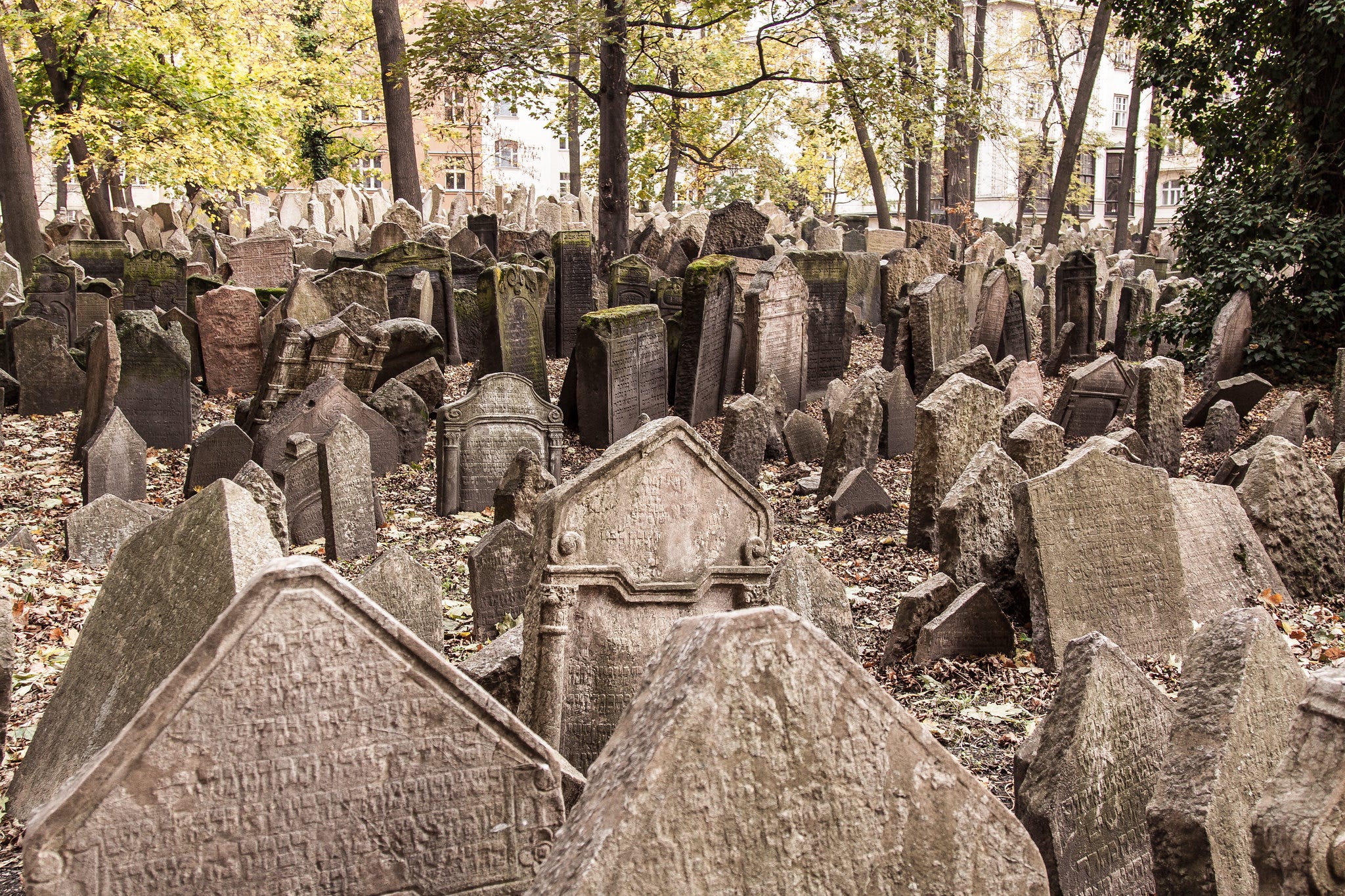
The Old Jewish Cemetery
is one great bouquet of grey stone
on which time has trodden.
I was drifting among the graves,
thinking of my mother.She used to read the Bible.
The two columns of letters
welled up before her eyes
like blood from a wound.The lamp sputtered and smoked,
and Mother put on her glasses.
At times she had to blow it out
and with her hairpin straighten
the glowing wick.But when she closed her tired eyes,
she dreamed of Paradise—
before God had garrisoned it
with armed cherubim.
Often she fell asleep and the Book
slipped from her lap.I was still young
when I discovered in the Old Testament
those fascinating verses about love
and eagerly searched for
the subversive passages on incest.Then I did not yet suspect
how much tenderness is hidden in the names
of Old Testament women.Adah is Ornament and Orpah
is a Hind,
Naamah is the Sweetness
and Nikol is the Little Brook.
Abigail is the Fount of Delight.But if I recall how helplessly I watched
as they dragged off the Jews,
even the crying children,
I still shudder with horror
and a chill runs down my spine.Jemima is the Dove and Tamar
the Palm Tree.
Tirzah is Grace
and Zilpah a Dewdrop.My God, how beautiful this is!
We were living in hell,
yet no one dared to strike a weapon
from the murderers’ hands—
as if within our hearts we did not have
a spark of humanity!The name Jecholiah means
“The Lord is Mighty.”
And yet their frowning God
gazed over the barbed wire
and did not lift a finger —Delilah is the Delicate, Rachel
the Ewe Lamb,
Deborah the Bee
and Esther the Bright Star.I’d just returned from the cemetery
when the June evening, with its scents,
rested on the windows.But from the silent distance now and then
came thunder of a future war.
There is no time without murder.I almost forgot:
Rhoda is the Rose.
And this flower perhaps is the only thing
that’s left us on earth
from the Paradise that was.
The Golem remained in storage.
All three of the defenestrated Catholics survived.
Are Elon Musk and Peter Thiel acquainted with “Rossum’s Universal Robots?” Do they know how the play ends?
Imagine being conquered by the Nazis only to be “liberated” by the Soviets.
Czechoslovakia was the only country to put Stalin’s portrait on its coinage; even the Soviet Union did not do that.
Three times while writing this piece, I typed “1938” instead of “1998.” Sixty years, just sixty years, between the Nazis terrorizing the city, and me drunk at Chapeau Rouge.
I never did meet Nadja Rybanova. Although, as it turned out, I delivered the wine to the right hands, for it was Ondrej, my seer and sage, who found me the place to stay in Prague.
“R.U.R.” is set in the future: it begins in the year 2000, and the acts skip decades. So the end of the play is right now.
The elections Nadja was out covering the day of my visit were for the Czech Parliament. The Communists got 658,550 votes, and picked up two seats. But the Social Democrats—the anti-fascists—won a third of the vote and added 13 seats.
There is no time without murder, yes. But it is our job, as humans, to fight against this, whether the murders are happening in Prague, in Los Angeles, or in concentration camps built by fascist regimes.
Finally, this: the name of the non-violent anti-Nazi resistance group in Germany was:
White Rose.
ICYMI
Great episode of The Five 8 on Friday. Jen Taub was our guest, and we spent most of the time talking about the Epstein-Trump imbroglio. Jen also had hopeful news about the ICE budget, which, as it happens, is not carved in stone:
A little Pink Floyd parody:
Photo credit: Edd Prince. The Old Jewish Cemetery, Prague.
The “Prague 1998” parts of this piece are revisions of something I wrote in 2009.
The oil man succeeds again, giving my Sunday a great start to the week. Nothing to say about this brilliant piece other than it was brilliant. I did note that while I identified as Polish, my grandmother's heritage, her husband, my grandfather was from Czechoslovakia. I never made it to Prague, an extreme disappointment but did visit grandma's birthplace, Krakow. My last name's spelling, ending with a y says I am Jewish but everyone in the family is Catholic, perhaps a slip of the pen at Ellis Island. Family trees are fascinating, to say the least.
My late mother used to find old coins and military cap badges from the American civil war whilst playing alone amongst the dunes outside of Jacksonville between the wars.
That Seifert poem cuts deep.
‘But from the silent distance now and then
Came thunder of a future war’
Some linguists have researched the epidemiological resistance of inherited culture. Apparently it takes seven generations for embedded ancestral linguistic memory to die.