

Sunday Pages: "Superman"
A film by James Gunn
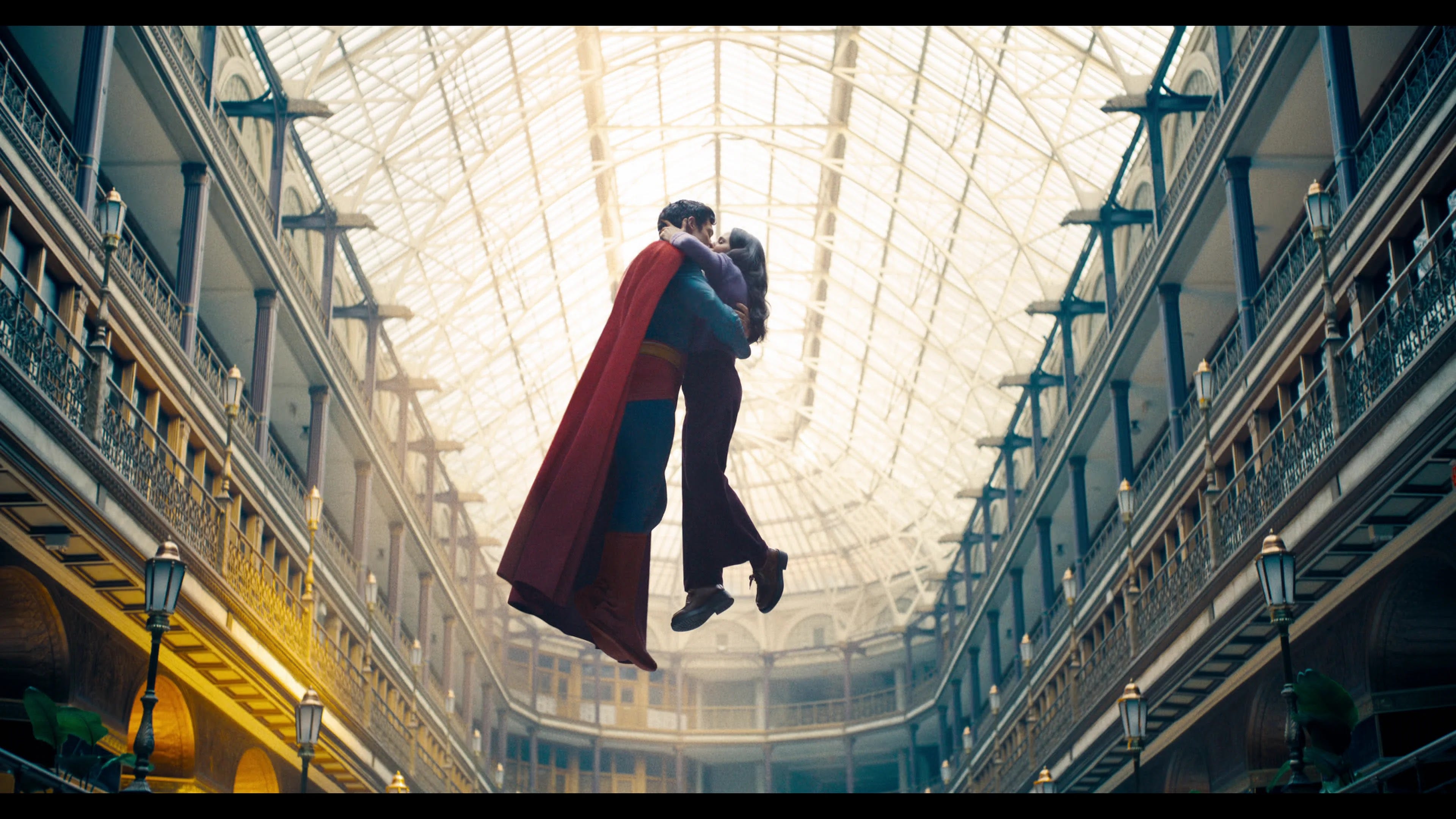
Dear Reader,
I first saw the trailer for the new James Gunn Superman a few months ago, during the NBA playoffs. My first reaction was an eye-roll and a dismissive, “Do we really need another Superman? Really? Why?”
Seriously: why do we keep recycling the same old tired movie franchises? Part of it is economics. Known commodities tend to perform better at the box office than original material, and when you’re outlaying a quarter billion for a motion picture, you’d like a little assurance that you’ll at least break even. The studios would rather deal with the devil—or the Kryptonian, as it were—they know.
But there’s more to it than that. Each franchise reboot is a time capsule, revealing something about the historical moment in which it was made. Superman II, the best of the original big-screen Man of Steel flicks and still one of the finest superhero movies of all time, is a reflection of the United States in 1980. It’s a Cold War film, a Battle Royale between two superpowers—one free, one tyrannical—where Lex Luthor is reduced to blundering comic relief. Even the plot is animated by anxieties about the ill intentions of the Soviet Union. What would happen, the filmmakers ask, if the world’s greatest superpower loses its invulnerability—at the exact moment when an equally powerful but sinister rival appears, literally out of thin air, to fill the power vacuum?
Well, what happens is, we’d win by using their own greedy, power-mad compulsions against them:
(Sidenote: No actor has ever delivered a finer performance than Terence Stamp as General Zod. Period, full stop. It’s simply not possible. Every line reading, every gesture, is sublime. Give him all the Oscars forever.)
Christopher Reeve is who everyone my age pictures when picturing Superman: earnest, humble, decent, homespun, handsome, strong but unthreatening, kind of a goober—in a word, Bidenesque. But as good as Reeve is, his Superman wouldn’t fly in 2025, any more than Biden could. The world has passed him by. We have more or less achieved, and in some cases flown right past, technology we only dreamed of in 1980. Things are too different now.
To wit: Even in the comic books, bald Luthor’s mad genius and relentless lust for revenge always seemed a little hard to believe; was he really that angry just because he lost his hair? Like, get implants, dude. Take some Propecia. Settle down. But Nicholas Hault’s Lex Luthor, Superman’s supervillain, is an all-too-familiar figure these days: an evil tech bro, his vast fortune dependent on lucrative government contracts, devoid of empathy, eugenics-obsessed, contemptuous of democracy, hellbent on destroying the world to crown himself king. Forty-five years ago, as seen in the above clip, the Earthling villain was subordinate to the baddies from Krypton. Not anymore.
So: do we really need another Superman? The answer, I can now confidently affirm, is: “Yes! Yes, we do!”
[NOTE: I’m trying to be as vague as possible, but there are some SPOILERS below.]
I was unprepared for how good this movie is, and how much I enjoyed it. Above all else, James Gunn’s film is the perfect summer blockbuster for this historical moment. If, as discussed, each franchise reboot operates as a societal mirror, a reflection of our values, here’s what 2025’s Superman holds in the highest esteem—what it asks us to recognize as important:
journalists
whistleblowers
immigrants
dogs
adoptive parents (of humans and of dogs)
diversity
self-sacrifice
courage in the face of tyranny
belief in the goodness of humanity
And, of course:
truth
justice
the American way
Lois Lane has always been the Daily Planet’s star reporter, and she is here as well (and as terrific as David Corenswet is in the leading role, we might still quibble about who is the best-ever Superman; there’s no question, it says here, that Rachel Brosnahan is the best-ever Lois Lane.) But it’s not just her. An intrepid Jimmy Olsen also cultivates sources to great effect, comic and otherwise. And the only thing that gave me more pleasure than seeing Bunk playing Perry White was the fact that he had a lit cigar in his mouth the entire time, even in the closed confines of Mr. Terrific’s spaceship, and no one even thought to object.
Really, the most unbelievable element of Gunn’s film isn’t that Superman can fly, or that Lex Luthor figures out how to create rifts in the space-time-continuum, or that Metamorpho turns his arm into green kryptonite. It’s that crack investigative journalists, who work for a newspaper, with the full support of their fearless editor-in-chief, use exclusive information given to them by a courageous whistleblower to expose the sinister and seditious motives of an über-wealthy tech bro—and, even more incredibly, that the American people believe the reporting and immediately turn on the prick. Talk about a Hollywood ending!
Flaws are what make fictional characters interesting, and Superman, as a character, has no discernible flaws. He’s impossibly handsome, impossibly decent, impossibly empathic, impossibly principled—and, oh yeah, he’s also far and away the most powerful living being on Earth. He has the strength to lift skyscrapers, and he can fly, and he has X-ray vision, and he has heat vision, and he moves just as fast as The Flash. He has a Fortress of Solitude somewhere in the Arctic because he’s impervious to extreme weather. The only thing that can hurt him is a bit of rock from his destroyed home planet—and there’s not much of that lying around the Earth.
Like Harry Potter—also an inherently boring protagonist, and for the same reasons—Superman was born the Chosen One, but he’s also worthy of being the Chosen One: the comic book version of LeBron James. From a screenwriting perspective, this is a challenging character to write. In his masterful script, Gunn cracks the code. Superman’s flawlessness—or, rather, the impossibly high standards of goodness and decency he sets for himself—is his flaw. Superman’s a square who rankles against his squareness. He’s powerful as all get out, but deeply, incurably uncool. He sincerely wants to save every living thing from harm, but when his motives are questioned, he loses his shit.
His entire ethos is beautifully summed up in an exchange with Lois Lane (who, in Gunn’s refreshing iteration, is already Clark’s girlfriend and knows he’s Superman right off the bat, sparing us the ridiculous oh-no-she-can’t-see-me-without-glasses nonsense):
LOIS
We’re so different. I was just some punk rock kid from Bakerline and you’re…Superman.CLARK
[offended] I’m punk rock.LOIS
[laughing] You are not punk rock. . . .My point is, I question everything and everyone. You trust everyone and think everyone you ever met is, like, beautiful.CLARK
Maybe that’s the real punk rock.
That’s sappy, sure, but it’s so sappy that it transcends sappiness. It’s okay to show your emotions! It’s okay to believe in the essential goodness of human beings! And, as Huey Lewis told us back when Reeve was still patrolling Metropolis, it’s hip to be square!
And that’s the genius of Gunn’s Superman. He manages to locate, develop, and explore the humanity of the least human human on Earth.
In the most recent wave of superhero movies—n.b.: the genre is called superhero, not bat-hero or spider-hero or iron-man-hero—filmmakers located their protagonists in the real world, or as close to the real world as possible. Hyperrealism was the goal. The Matt Reeves Batman movie, for example, which I also loved, is great in part because it ranges as far from the comic book realm as it can. Batman is very much a real person, as is Catwoman, and the Riddler, and the Penguin.
Gunn is like, “You know what? If I want realism, I’ll go home and watch some Emmy-nominated HBO series. The movie is based on a comic book! It’s okay to make it look and feel like a comic book!” And so, unlike Reeves, or Christopher Nolan, or Zach Snyder, who directed the previous Superman movie, Gunn leans into the comics. He builds a world that, while similar to our own, is its own distinct place, with its own distinct culture, politics, technology, and so on. This is refreshing. Are we really so cynical that we can’t unironically enjoy occupying the comic book realm for two hours and nine minutes? (I do not miss the ponderousness of the MCU pictures; the extra hour in those Avengers movies is, ahem, superfluous.)
That doesn’t mean Gunn shies away from the villainous and cruel. We see destruction, we see unfairness, we see dissidents imprisoned against their will, we see illegal invasions and black-site prisons and callous rich-guy behavior that threatens the very future of life on Earth. But what we want and need in a Superman movie is what we want and need in real life right about now: Superman to save the day!
Watching the bad guys lose on the big screen gives us hope that the bad guys will lose IRL, too. Sometimes it really is that simple. Like, it feels good to see the good guys prevail! It’s inspiring! More of that, please!
The same MAGA influencers who blew a gasket over Barbie two summers ago are similarly panty-twisted about Superman. (That Barbie and Superman are among the most iconic pop-cultural symbols of Americanness is perhaps a tell on where the influencers’ allegiances really lay.) They object to the emphasis on Superman’s immigrant status; Clark Kent may have grown up in Kansas, but Kal-El was not born in the United States, so does not enjoy birthright citizenship. They object to Lex Luthor’s similarities to Elon Musk, Marc Andreessen, and Peter Thiel—although Hault’s Luthor is much more compelling, way smarter, and, frankly, far less of a cookie-cutter comic book villain than those three Silicon Valley weirdos; that his voice sounds like Young Angry Tom Cruise only enhances the effect. They object to Superman being removed to a secret, inaccessible prison that looks uncannily like what Donald Trump, Marco Rubio, Kristi Noem, and Stephen Miller have cooked up in El Salvador. “Hollywood is mocking ICE!” they bleat.
But here’s the thing: Gunn’s Superman was written and shot months before Trump and his fascist goons even took office. Secret, high-tech detention centers built to confine Superman and his preternatural ilk are a staple of superhero universes; recall the plastic prison in which Magneto is incarcerated in X-Men. If MAGA recognizes their empathy-deficient heroes in the film’s main bad guy, it’s not because Lex Luthor is based on Thiel and Andreessen and Musk; it’s because Thiel and Andreessen and Musk are themselves comic book villains. Similarly, the small contingent of filmgoers who see the crooked president of Boravia and his invading army of colonizers as cinematic stand-ins for Netanyahu and the IDF are mad at the wrong person. It’s not that Gunn is antisemitic, or even anti-Israel; it’s that with regards to Gaza, Netanyahu is behaving like a comic book villain. As for ICE, I mean, they’re Stormtroopers, ffs! We’re not supposed to like them!
If MAGA wants superhero-movie villains to stop resembling the objects of their cultish affection, maybe they should select heroes who are not real-life comic book villains.
One of the many genius aspects of Gunn’s script is that Superman is ultimately about a guy trying to rescue his stolen dog. (Unfortunately, said super-dog is called Krypto, which was a cuter name before DOGECOIN and $TRUMP were a thing.) The pup falls into Lex Luthor’s clutches; Superman aims to get him back. That’s the movie’s MacGuffin.
An X user and superhero movie aficionado named Christian says, “There’s a line in Superman, a line Superman himself says that, for me, captures the essence of who he is better than anything else in the entire movie,” and I couldn’t agree more. Here is the exchange, which comes after our hero has failed to track Krypto down:
SUPERMAN
I’m going to turn myself in.LOIS
[shocked] Why?SUPERMAN
Maybe they’ll take me wherever they took the dog.LOIS
It’s just a dog.SUPERMAN
I know. And he’s not even a very good one. But he’s alone—and he’s probably scared.
Superman gives himself up, submits to Lex Luthor, winds up imprisoned in this horrible “pocket universe” detention center that makes CECOT look like Club Med, and almost dies—just to try to rescue a pet dog he doesn’t even like.
When you boil it down, that’s what MAGA really objects to here: kindness, selflessness, sacrifice. The movie assures us that these things (still) matter.
Superman has the power to conquer the world, enslave the human population, and make short work of anyone foolish enough to rise against him. This is, come to find out, the career path his biological parents intended him to take. They envisioned Kal-El as a faster-than-a-locomotive Attila the Hun, Genghis Khan who can leap tall buildings in a single bound. Instead, he’s out there saving squirrels. Lex Luthor, who wants nothing more than to conquer the world, enslave the human population, and make short work of anyone foolish enough to rise against him, cannot fathom—cannot grok, we might even say!—how anyone with so much power would willingly choose not to use it to acquire even more. Unlike Musk or Andreessen or Thiel, Luthor really is the smartest guy in the world, but he can’t figure this out. He can’t solve the puzzle. And it drives him mad.
I expect that with the MAGA audience, it is much the same.
Superman is, alas, a fictional character. And it’s a lazy bit of magical thinking to sit around and wait for some Savior from on high—be it Superman, Jesus, or Jack Smith—to get us out of this mess.
But even in Gunn’s movie, that’s not what happens. Superman does not swoop down and save the day solo. Even he can’t operate all alone. The “Justice Gang”—Green Lantern, Hawkgirl, and Mr. Terrific, who are all chef’s-kiss awesome—stop the Boravian invasion. The Daily Planet reporters expose Luthor’s mendacious treachery. The ditsy social media influencer Eve Teschmacher collects the evidence the reporters use. And Superman himself is saved by Lois Lane—whose only superpower is being a good writer who refuses to shy away from the truth.
What Superman tells us is that we are all capable, in our own way, of being superheroes—and, if we join forces and work together, of saving the world.
That sounds corny, I realize. But corny is the real punk rock.

ICYMI
Fantastic episode of The Five 8 on Friday. With LB taking the week off, I was joined by four former USAID diplomats: Robbie Harris, Michelle Girard, Sara Yim, and Erica Kaster.
PROGRAMMING NOTES
I will be on vacation, and PREVAIL will be on hiatus, until Friday, August 1. The full summer schedule is here:
Sunday, July 20—YES
Tuesday, July 22—OFF
Friday, July 25—OFF
Sunday, July 27—OFF
Tuesday, July 29—OFF
Friday, August 1 through Sunday, August 17—YES
Tuesday, August 19—OFF
Friday, August 22—OFF
Sunday, August 24—OFF
Tuesday, August 26—OFF
Friday, August 29—BACK
And not to raise your expectations, or to jinx it, but every time I go away for an actual vacation, big news breaks. So…fingers crossed.
Have a great rest of the month! Thank you, as always, for your support! Up, up, and away!
I said to my hubby my friend Greg recommended the new Superman movie, do you want to go see it? He said do we really need another Superman movie?!! lol Maybe my grandson will go with me. I could use a feel good movie. The Five 8 was fantastic. Those four women were articulate, caring people. What is our vision for the country after we rid ourselves of all the corruption that is going on now. Have a great vacation and I look forward to your return. 🙏
Hey, you’re supposed to be on vacation! But this is a fun read and I’ll go see the movie on your recommendation. And BTW, Trump’s buddies all look like comic book villains, too. I mean, Roger Stone and Rudy Guiliani, etc. look like they came out of central casting….
Thanks for the review!