

Sunday Pages: "Texas Rangers"
A traditional, arranged by Richard Shindell
Dear Reader,
In 1999, Sierra Leone, a West African nation the size of South Carolina, was in the midst of a long and brutal civil war. The causes are complex, but the violence was exacerbated by the land’s rich abundance of natural resources: gold, bauxite, aluminum, and, most famously, diamonds; the Leonardo DiCaprio film Blood Diamond is set in Sierra Leone during its civil war.
The top Associated Press reporter in West Africa at the time had covered wars in Afghanistan, Kashmir, and Cambodia. “Nothing,” he wrote later, “prepared me for the cruelty of Sierra Leone,” a country “[r]ated by the United Nations as the worst place in the world to live” that had “staggered through a series of violent upheavals since it gained independence from Britain in 1961.” He continued: “The latest band of insurgents was targeting civilians, poking out eyes, hacking off limbs.”
Founded in 1846, the AP is a not-for-profit cooperative owned by its member newspapers. The idea is both brilliant and simple: rather than have every media outlet in the country send a correspondent to London, or Hong Kong, or Beirut, the outlets would pool their resources, send over one reporter, and they could all use his or her work. Given America’s apathy towards Africa, it is likely that the Associated Press reporters in Freetown, Sierra Leone, were the only foreign correspondents in that country covering the war.
In January of 1999, three of those reporters were shot at, at a military checkpoint outside of Freetown. One of them, the photographer David Guttenfelder, was badly cut by glass shattered by the gunfire. Another, Ian Stewart, the bureau chief who wrote the lines quoted previously, was shot in the head but survived. The third, Myles Tierney, a TV producer, was killed.
I was working for the AP at the time, as a recruiter in the human resources department. The company handled the incident with notable compassion and appropriate gravity. Tierney became the 24th AP reporter who died on the job. People felt for him, even those, like me, who hadn’t known him. Among other things, it was a reminder that any AP journalist, even those working in places far less dangerous than Sierra Leone, were putting themselves at risk by doing the job—the most essential job there is in a democracy.
There was a memorial, held in a large auditorium, and all the employees attended. I remember one of the eulogists saying that, because West Africans used the metric system, they would refer to Myles Tierney as “Mr. Kilometer.” Clearly everybody loved the guy. He sounded like an amazing human—and he was 34 years old, and he was no more.
But what I remember most of all was something written by the bureau chief, Ian Stewart, long after the attack. He’d been shot in the head. He was bleeding in the backseat of a station wagon on some crappy road in some inconsequential country in West Africa, and if he’d been wounded a little later in the day, he would have missed the last flight out and died in Sierra Leone. That he even made it to London alive was itself a miracle.
By December of 1999, Stewart had recovered enough to write about his experience.1 He’d gone from being bedridden to walking in short bursts, from using a wheelchair to using a cane. His left arm was paralyzed. He was living in Toronto, with his mother and father, as he recovered. He turned 33 in 1999. “Home with my parents for the first time since I was 18,” he wrote, “I feel like the oldest teenager in Canada.”
It’s a remarkable piece of writing—and one I’m not sure the higher-ups at AP were thrilled about. Stewart details the grueling months of recovery, but he does not pity himself, nor does he want us to pity him. It takes enormous strength and will to recover from such an injury as well as he did, but he wants no flowers for that, either. If anything, he seems embarrassed by the attention. He is incredibly candid about how the incident affected his relationships with his girlfriend (they broke up) and with the photographer who was with him and suffered glass cuts (they don’t really talk anymore). He worries about his parents, how this affected them.
But the end of the piece is what’s stuck with me—especially now, as Trump and Hegseth seem hellbent on sending ground troops to Iran, in what would be one of the stupidest, most ill-conceived and unnecessary wars in the millennia-long annals of warfare. Stewart writes:
Every morning I wake and prepare myself for another day. I wonder where the strength comes from. I wonder if it will still be there tomorrow.
I no longer wonder if it has all been worth it.
For war correspondents there is an age-old question: “Is this story worth risking your life for?” There are always some who say yes, lured by both the story and the danger.
If some stories are worth the risk, Freetown wasn’t one of them.
Myles, David and I were naive to hope our reporting could make people care about a little war in Africa. In fact, Freetown might never have made your daily newspaper had it not been for the death of one Western journalist and the wounding of another.
Will I continue to work as a journalist when I am well enough to work?
Yes, and most likely I’ll go back overseas.
Will I risk my life for a story again?
No. Not even if the world cares next time.
Stewart doesn’t actually say the words that I remember, memory being faulty: It wasn’t worth it.
In 1837, nine years before AP was founded, Texas was newly independent. It was a vast territory, sparsely populated. Settlers were in constant danger from all sides: insurgent Mexican soldiers, roving brigands and highway robbers, and, of course, the local tribes of Native Americans the Texan colonizers were eager to displace.
To protect the settlers, Stephen Austin, the Father of Texas, formed a special law enforcement unit with jurisdiction across the state: the Texas Rangers. The outfit is an integral part of the lure of the Old West, with the Rangers generally depicted as heroic keepers of the peace. The Lone Ranger was called that because he used to be a Texas Ranger. Sometimes they really were heroes, especially in tracking down bank robbers and the like.
But in the nineteenth and early twentieth centuries, the Rangers were basically Texas’s version of a secret state police—oprichnina in Stetsons and spurs. As with ICE, the organization attracted racists—angry, single white men who liked to beat up on brown people. And not all of their engagements ended heroically.
The Battle—really, “skirmish” is a more accurate word—of Stone Houses took place on November 10, 1837. A month earlier, members of the mighty Kichai tribe, who were hostile to the white colonizers, raided Fort Smith and then fled. Some Rangers mobilized to track them down. The group split in half when two of the head Rangers got in a fight, almost certainly about something silly.
The smaller of the two groups met the Kichai on a dusty plain two hours west of Dallas. The tribesmen prepared to raid what they thought were three stone houses but were, in actuality, just mounds of dust. There were 18 Rangers and almost 200 Kichai. Given the numbers, what happened next was beyond stupid. Here is the entry from the Texas State Historical Association:
On November 10 the Rangers came upon the Kichais, who had stopped running and were now primed for attack. It is said that Cherokee and Delaware Indians who were present tried to act as peace agents, but that one of the Rangers, Felix McClusky, jumped an Indian and killed him. When reprimanded, McClusky replied that he would kill any Indian for a plug of tobacco and then showed one he had taken from the dead man's body. This infuriated the Indians, and they attacked. The Rangers abandoned their horses and sought protection in a shallow ravine. In the first attack the Kichais lost their leader, but they retired to elect a new one and soon resumed the battle. The fighting continued for two hours, often at close quarters, until the Kichais decided to smoke out the rangers by setting fire to the prairie. The Rangers charged through the smoke and waiting Indians and escaped into the woods. Four Rangers died in battle before the fire and six more during the escape. Eight Rangers survived and arrived at the Sabine River settlement on November 27, having walked all the way after losing all their horses and equipment.
That battle skirmish was, I believe, the inspiration for the traditional folk song “Texas Rangers.” The earliest recording I could dig up was from Harry McClintock, aka Haywire Mac, a singer, songwriter, guitarist, poet, radio personality, and activist with the IWW—a remarkable and colorful character.
I know the song because the folk musician Richard Shindell covered it on his 2007 album South of Delia. There are covers, and then there are covers—versions of a song that transcend the original, that alchemize the source material to create something distinct, new, and better. For example, “The Tide Is High” is a 1967 track by John Holt and the Paragons; you would never know that, listening to the standout Blondie cover. Jeff Buckley’s “Hallelujah” far surpasses the Leonard Cohen original. And I’m sure even Bob Dylan would grudgingly concede that Jimi Hendrix’s “All Along the Watchtower” is way better than his shrill recording. What did Otis Redding say, when he heard Aretha Franklin’s version of “Respect,” which tune he wrote? “She done stole my song!”
Shindell does this with Bruce Springsteen—no small feat. As the opening track on the eponymous album, the original “Born in the USA” is loud, driving, energetic. It sounds anthemic, like a patriotic song. Springsteen was probably going for irony, but the arrangement has made it easy for Republicans to appropriate it—and misconstrue the meaning.
Shindell recognizes that “Born in the USA” belongs more on Nebraska, Springsteen’s bare, quiet, four-track album, than on Born in the USA. He slows it down, strips it bare, and brings the focus to the lyrics of what is more dirge than anthem. Springsteen’s voice is so husky, as if straining to be heard over the band, that it’s easy to miss the key lines of the song, which Shindell smartly stresses:
I had a brother at Khe Sanh,
Fightin’ off them Viet Cong.
They’re still there,
He’s all gone.
“Born in the USA” is about a down-on-his-luck guy, abused as a child, who joins the army and goes to Vietnam to avoid jail; returns to find no job prospects; and winds up in prison. Shindell mines the song for all it’s worth, even altering the melody of the chorus slightly to hammer home the point:
He pulls the same trick with “Texas Rangers.” The other versions, especially McClintock’s, are too jaunty. Some of them skip the last stanza, and thus miss the point completely. Shindell tweaks the lyrics slightly, or else cobbles them together from different versions, and (wisely) skips several.
And his musical arrangement is exquisite, pausing the story at various intervals for instrumental interludes, to give us time to reflect. The effect is devastating. He squeezes every last bit of juice out of it. I told my wife I was writing about this today, and she said, “I got chills just thinking about that song.”
Here are the lyrics that Shindell uses:
Come, all you Texas Rangers, wherever you may be.
I’ll tell you of some trouble that happened unto me.
My name is nothing extra, so that I will not tell,
And here’s to all you Rangers, I’m sure I wish you well.When at the age of sixteen I joined this jolly band,
We marched from San Antonio down to the Rio Grande.
Our captain he informed us—perhaps he thought it right—
“Before we reach the station, we’ll surely have to fight.”
Then comes the first musical interlude, to build suspense. He continues:
I saw the smoke ascending. It seemed to reach the sky.
The first thought that came to me? “My time has come to die.”
And when the bugles sounded, our captain gave command—
“To arms! To arms!” he shouted, “and by your horses stand!”I saw the Indians coming. I heard their awful yell.
My feelings at the moment, no human tongue can tell.
I saw their glittering lances; their arrows around me flew,
Till all my strength had failed me—and all my courage, too.We fought for five full hours before the strife was o’er.
The likes of dead and wounded, I’ve never seen before.
And when the sun had risen, the Indians, they had fled.
We loaded up our rifles and counted up our dead.Now all of us were wounded—our noble captain slain.
And when the sun was shining across the bloody plain,
Six of the noblest Rangers that ever roamed the West
Were buried by their comrades—with arrows in the breasts.
And now a second musical interlude, where Shindell brings it down; the quiet reflects the battle being “o’er.”
Then comes the killer last verse, simple and heartbreaking:
Perhaps you have a mother; likewise a sister, too.
Perhaps you have a sweetheart, to weep and mourn for you.
If this be your position, although you’d like to roam,
I’ll tell you from experience—you’d better stay home.
In 1999, Tierney and Stewart were journalists who chose to go to literally the most dangerous place on earth to cover a conflict that most Westerners didn’t even know was being waged. You could fit every American who legitimately gave a shit about the Sierra Leone civil war in the auditorium where Tierney’s memorial was held.
Even so, the journalists were there on their own volition. They were free to leave at any time.
This is not true of our armed forces. Servicemembers are contracted to serve, and the consequences for refusal of orders are dire. Under the command of the warmongering drunk Pete Hegseth, who has no sympathy for conscientious objectors, they have little recourse if deployed to the Middle East.
Hegseth is a Christian nationalist. He seems sincerely to believe that this fight he picked with Iran is a holy war—that Jesus wants what Whiskey Pete wrongly believes is the Christian nation of the United States to exterminate Muslims from the face of the earth.
That is, more or less, what happened to the Kichai Indians, who fought the Texas Rangers at Stone Houses. The tribe has been almost completely wiped out—either killed off, displaced, or fully assimilated. In 1999, there were four full-blooded Kichai left. Their rich, vibrant culture is a memory, their language extinct.
If this is the future Hegseth envisions for Iran, he’s even dumber than I thought. As the Iranian media has repeatedly pointed out, in its trollingly genius propaganda campaign, Persia has been around for millennia, and is unlikely to die out anytime soon. A ground invasion of Iran, whether Kharg Island or the mainland, is a suicide mission—all the risk of the Normandy landings, with none of the upside.
To paraphrase Ian Stewart: If some wars are worth fighting, Iran isn’t one of them.
On this Easter Sunday, may our servicemembers, no matter what their religious beliefs, note that, pace Pete Hegseth, Jesus was the Prince of Peace, not the bringer of war. May they repudiate the bloodthirsty blunderers heading the White House and the Pentagon, and instead heed the wisdom of that old folk song, as true now as the day it was written:
You’d better stay home.
ICYMI
The Five 8 marked its four-year anniversary with a special episode, featuring Nina Burleigh, Lisa Graves, and the man the myth the legend, the great CHUNK.
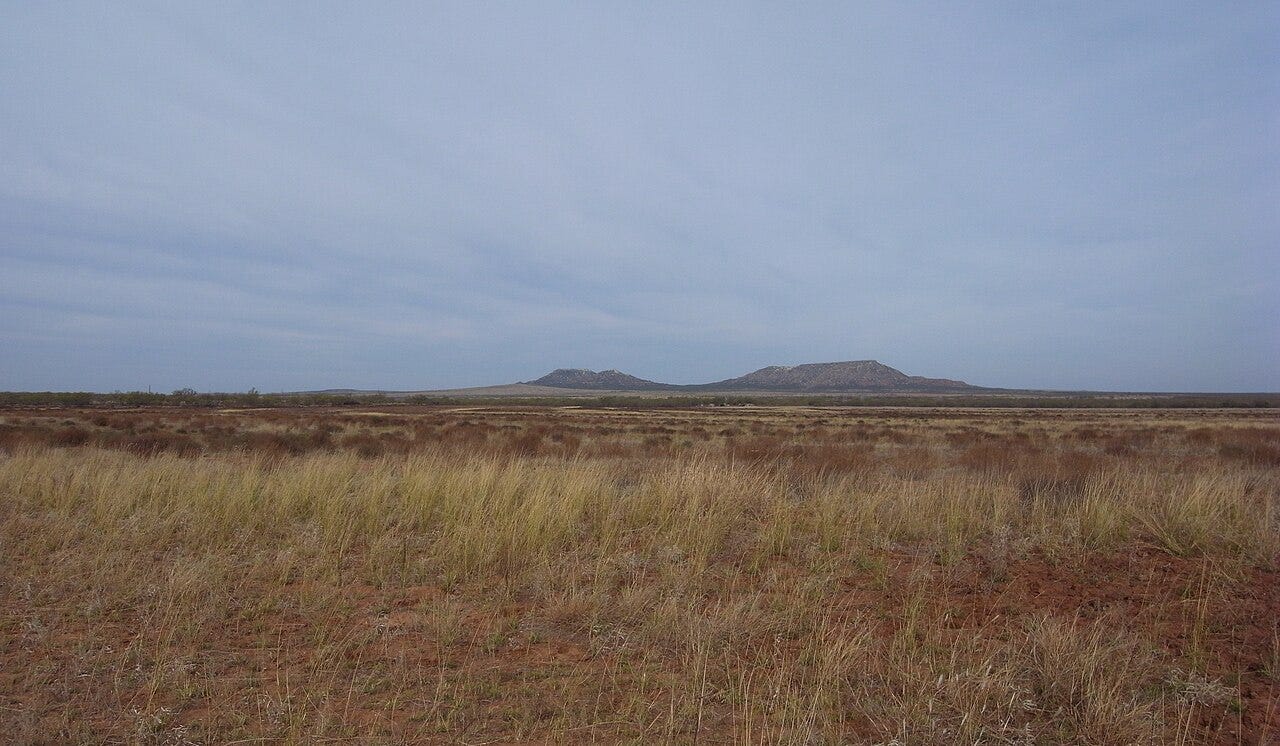
Photo credit: Leaflet. Stonewall County, Texas.
Oh Greg, you sure have a way to cheer me up on a rainy Easter Sunday. Sob!
When a woman of my era wonders why she never met her "Mr. Right," I think, because he was sent home from Vietnam in a body bag. Republicans say they want more babies. Maybe preach in their religion of dollars about numbers of consumers to be lost. Thanks for the important Easter message. I bet their Easter baskets are full of skewered rabbits and ketchup-covered Peeps.