

Sunday Pages: "West End Girl"
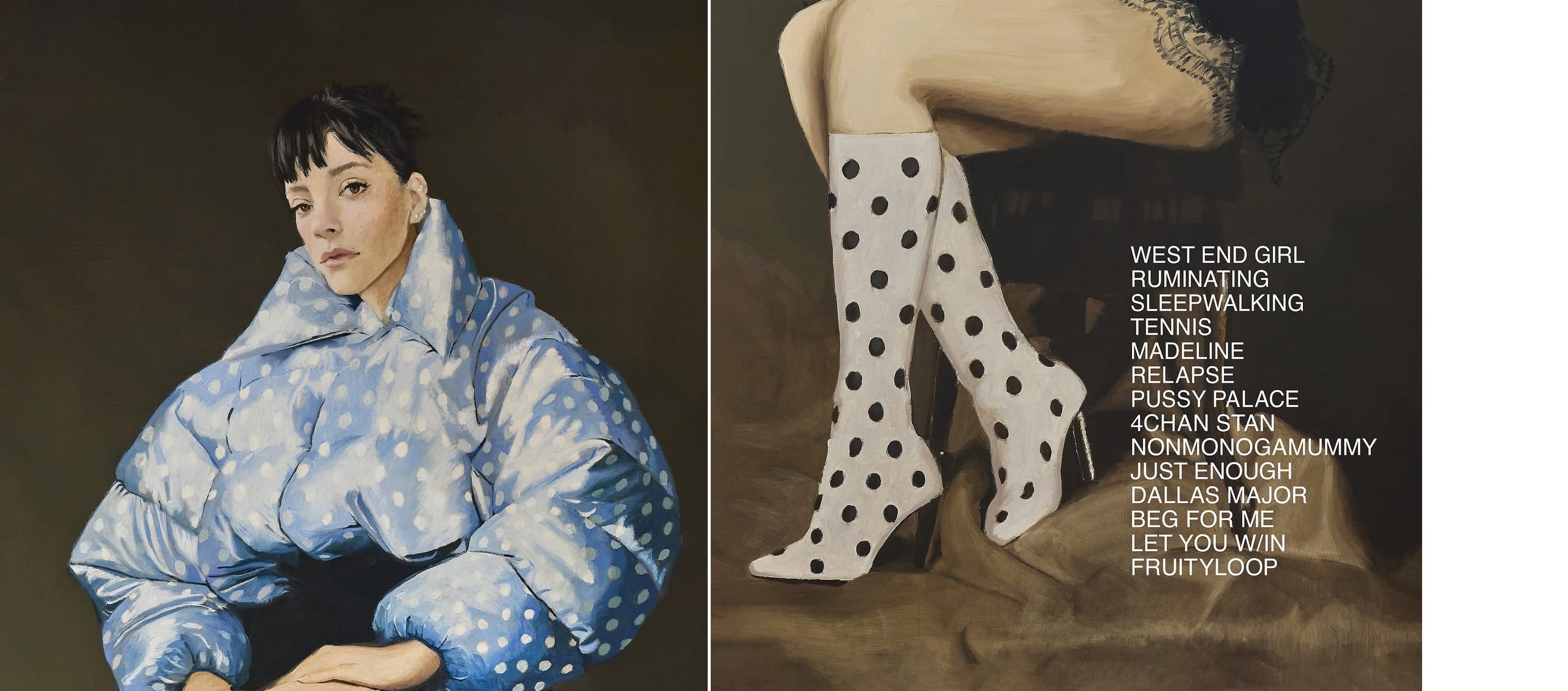
An album by Lily Allen
Dear Reader,
I first became aware of Lily Allen in 2009 or so.
We had moved north from the city in June of 2005, when our son was six months old, to a sleepy Hudson Valley outpost where we knew not a single soul. Our second child joined us the following summer. And so for about five years, my wife and I were both home with these little kids, operating on very little sleep, isolated from almost everyone we knew, learning on the fly how to be both parents and homeowners.
By 2009, we were sick to death of music written and produced for children. I’m still fond of Yo Gabba Gabba, and the Baby Einstein videos, and some of the tracks from Thomas the Tank Engine, which are way better than a show about anthropomorphic trains deserves, but there’s only so many times you can rest a two-year-old on your knee and watch a grinning Dan Zanes on YouTube. This was the same period of pop-cultural history, it should be noted, where stay-at-home-moms the world over began to lust after Steve from Blue’s Clues—a phenomenon that, to me, is perfectly explicable.
Since leaving college in 1995, I’d successfully abstained from Top 40, missing out on a woebegone decade highlighted by Britney Spears, Justin Timberlake, Destiny’s Child, and the Jonas Brothers. But by 2009, we were desperate for something—anything—new. So we turned on, and turned up, the radio. And we found, to our pleasant surprise, that it was good!
Twenty oh-nine was hailed as “The Year of the Woman” in pop music. A wave of supremely gifted female twentysomethings—Amy Winehouse (b. 1983), Katy Perry (b. 1984), Lily Allen (b. 1985), Lana Del Rey (b. 1985), and Lady Gaga (b. 1986)—crested like a Top 40 tsunami on the music scene. And we got to ride it! (The video for “Bad Romance”, with its “Bath Haus of GaGa” and creepy bug-like dancers crawling out of coffin-like white pods and sexy hospital orderlies force-feeding the pop star a glass of icky poison and Gaga half naked with what appears to be a bejeweled lampshade on her head crawling towards a gross Pete Hegsethian villain, is probably not the most appropriate clip to show a toddler, but my three-year-old couldn’t get enough of it.)
This was a transitional phase in terms of technology; I had to download individual tracks from iTunes, create a playlist, and then burn it to a CD to play it in the obligatory minivan—which we spent an inordinate amount of time in, despite rarely driving anywhere more than half an hour away. So I came to know, and to love, a lot of radio hits from 2009-2016.1
Each artist had a distinct vibe: Lady Gaga was outrageous, Lana Del Rey was jaded, Katy Perry was cutesy, Amy Winehouse was tragic.
As for Lily Allen, she was funny, combining piercing wit, clever wordplay, self-deprecating humor, and a keen satirical eye in a sophisticated way that belied her youth. Like, she managed to write a song called “Fuck You”—in which she actually sings, in the chorus, “Fuck you, fuck you very very much”—and have it played on the radio.2
Not that she dug being funny and clever. “The Fear,” an ironical cri de cœur against consumerism and the Kardashianization of the culture, and one of my favorite Allen songs, begins:
I wanna be rich and I want lots of money.
I don’t care about clever, I don’t care about funny.
I want lots of clothes and fuckloads of diamonds.
I heard people die while they’re trying to find them.
Allen was somehow just 20 years old when, on a track called “Everything’s Just Wonderful” (although nothing actually is, other than the song itself), she came up with a A/B/A/B rhyme that transcends the genre and belongs in the Great Lyrics Pantheon with the finest comic work of Cole Porter and W.S. Gilbert:
In the magazines,
They talk about weight loss—
If I buy those jeans,
I can look like Kate Moss.
We’d have to open a new Culinary Institute of America to produce enough chefs to generate the amount of chef’s kisses that deserves.
So I have long known what Lily Allen’s capable of. But even that didn’t prepare me for her extraordinary new album, West End Girl.3 I knew it was about the breakup of her marriage. I knew it was autobiographical—not semi-autobiographical; autobiographical. And, because there is the Internet, I knew that the cheating husband who is the album’s antagonist is [checks notes] the dude who played Hopper on Stranger Things (which makes me hate less the season where he spends all that time in a Siberian prison).
Taylor Swift (b. 1989) has made a career alchemizing her, ahem, bad romances into gold records (multi-platinum records, if you wanna get technical). It’s her lane, her calling card. People who can’t name any of her songs are well aware that Swift has a chequered, tortured dating history. But as good as these confessional songs are, there’s something performative about them. We never get the sense that she’s being truly vulnerable. Like a novelist who bases characters and plot lines on actual people and real things that have happened to her, she tells us only what she wants us to know. She’s always in control of the narrative. There’s nothing dangerous about Taylor Swift.
When I first heard about West End Girl—which came out on October 24th—I assumed it would be in the Taylor Swift mode. But this is a whole different animal. Lily Allen is not writing a novel; she’s writing a memoir—or, at least, that’s what it feels like. Swift never achieves this level of intimacy. Allen is so frank, so candid, so vulnerable, that it’s not enough to say she’s standing naked before us. We can see through her entirely—beneath her skin and into the depths of her soul. This isn’t TMI; this is MRI.
The 14 tracks—written with Violet Skies, Haley Gene Penner, Chloe Angelides, and Blue May, and encompassing a variety of styles—is very much “Lily Allen,” but once again, Allen has transcended the genre and even the form. West End Girl is a song cycle, telling the story of the end of the marriage, with all of the brutal details laid bare. And yet, for all its serious subject matter, it’s so catchy, and so good, that I’ve listened to it on a loop all week.
The album opens with the title track, a buoyant number that whisks us along, as she and her husband and her two kids set up shop in New York, across the pond from her family and friends in Britain:
Now I’m looking at houses
With four or five floors,
And you found us a brownstone,
Said, “You want it? It’s yours.”
So we went ahead and we bought it,
Found ourselves a good mortgage,
Billy Cotton got sorted,
All the furniture ordered.
I could never afford this.
“Billy Cotton” being, Google informs me, an interior designer and architect out of my price range and, also, apparently, Lily Allen’s. I love that she regularly sings about the mundane aspects of real estate; I can’t think of anyone else who does this. We can contrast the Allen of 2025 with the Allen of 2006, who sings, on “Everything’s Just Wonderful,”
I wanna get a flat, I know I can’t afford it.
It’s just the bureaucrats who won’t give me a mortgage.
It’s very funny ‘cause I got your fucking money,
And I’m never gonna get it just ‘cause of my bad credit.
Back then, she could easily afford the place but doesn’t get it; now, she can’t afford it but does.
It’s her husband, we learn, driving the car:
You were pushing it forward
Made me feel a bit awkward
Made me feel a bit awkward
No sooner do they get all settled when she gets the lead in a play in London. (Allen comes from a family of actors; her father is a veteran comic actor, and her brother Alfie was a regular on Game of Thrones.) Her husband’s response to this new development is so unsettling that the song literally stops—just stops dead, and we listen to her side of an unpleasant FaceTime conversation with him. (His voice, crucially, is never heard, on this song or anywhere else on the album; we only hear hers, with its delightful London accent.) As they talk, the music in the background starts to swell, symbolizing life going on all around her. Who stops a rollicking opening number cold to insert a distressing, and long, phone call? It’s a daring choice, and it sets up everything that follows.
On “Ruminating,” she’s in London and he’s in New York. Some arrangement has been made, we discover, that allows him a bit of sexual leeway. But in practice, she’s having difficulty handling it. She’s in a London hotel room obsessing over him hooking up with someone else—and bemoaning his blasé attitude about the whole thing:
I told you, all of this has been too brutal.
You told me that you felt the same, it’s mutual.
And then you came out with this line so crucial,
Yeah, “If it has to happen, baby, do you want to know?”
In “Sleepwalking,” a musical throwback to the fifties, the happy melody and arrangement contrasts with the uncomfortable (and, once again, one-sided) conversation the two of them are having:
You don’t stop talking,
And I’m just sleepwalking.
See your thoughts forming.
Baby, stop it, it’s three in the morning.
Together again, she discovers the extent of his betrayal in “Tennis.” Toward the end of the song, the music drops out, and Allen asks, quietly but with venom in her voice, “Who the fuck is Madeline?”
We soon find out. “Madeline,” a sort of flamenco number, plays out the exchange between her and her husband’s paramour—who turns out to be a bit vapid, and like her, also a victim of his deception. Madeline makes an appearance, reading what sounds like an email:
I hate that you’re in so much pain right now. I really don’t want to be the cause of any upset. He told me you were aware this was going on, and that he had your full consent. If he’s lying about that, then please let me know, because I have my own feelings about dishonesty. Lies are not something that I want to get caught up in.
And then, just to show that she’s an ally:
You can reach out to me any time, by the way, if you need any more details or you just need to vent or anything.
The sign-off, as the music drops out and the song ends, is devastating:
Love and light,
Madeline
In “Relapse,” she worries that, if she takes him back, the same thing will happen again, and she will have wasted even more time.
I need a drink,
I need a Valium.
You pushed me this far,
And I just need to be numb.
And then we come to the album’s Spotify hit, the soaring and sad “Pussy Palace.” The eponymous dwelling is not a palace at all, but a pied-à-terre in the West Village—a long and annoying subway ride from Brooklyn; the F train sucking is one thing about NYC that never changes. This is supposedly his man-cave, his “dojo,” but actually, as she learns, the love shack where he has his trysts—which he doesn’t bother to clean up after:
I found a shoebox full of handwritten letters
From brokenhearted women wishing you could have been better,
Sheets pulled off the bed,
Strewn on all on the floor,
Long black hair probably from the night before,
Duane Reade bag with the handles tied,
Sex toys, butt plugs, lube inside,
Hundreds of Trojans, you’re so fucking broken,
How’d I get caught up in your double life?
So yes, she is “looking at a sex addict.”
In “4Chan Stan”—a song title for the ages—she continues to investigate, finding clues of his various betrayals everywhere. He’s barely attempted to even hide it. The only thing he hides, in fact, is the identity of his primary sidepiece (who is not Madeline but someone else entirely):
Why won’t you tell me what her name is?
This is outrageous
What, is she famous?
Say that it’s over, do you mean a hiatus?
The temporary ceasefire in this war is an agreement to an open marriage. As she makes clear in the wonderfully titled “Nonmonogamummy,” she’s not all that into it:
I’ve been trying to be open,
I just wanna meet your needs,
And for some reason,
I prefer to people pleasing.
I’ll be your Nonmonogamummy.
I’m just trying to be open.
That track also provides one of the album’s most brutal lines:
I changed my immigration status
For you to treat me like a stranger
In “Just Enough,” the situation gets even worse, as she suspects that he knocked up his mystery woman:
Why are we here talking about vasectomies?
Did you get someone pregnant?
Someone who isn’t me?
My favorite song on the album is the catchy and old-school-Lily-Allen-y “Dallas Major.” The title refers to the pseudonym she uses on her dating apps, and the lyrics consist mostly of what she writes in her Tinder bio:
My name is Dallas Major,
And I’m coming out to play,
Looking for someone to have fun with
While my husband works away.
I’m almost nearly forty,
I’m just shy of five-foot-two.
I’m a mum to teenage children—
Does that sound like fun to you?
The album ends with three songs that take us on a journey from the nadir of the heartbreak to epiphany that leads to her recovery:
“Beg For Me” is her at her most pathetic—still willing, and still hoping, that he will give her what she needs (which isn’t much) to get her to stay. The gaslighting is at its most powerful—even as her friends all tell her he’s “deranged,” she’s not yet ready to move on.
By the penultimate song, ““Let You W/In,” her despair is beginning to morph to indignation, if not outright anger. She’s starting to look at the situation objectively, and understand how badly he’s hurt her, and the sacrifices she’s had to make to keep up the charade:
And I’m expected to be nice
Picking up the pieces
What is it you sacrifice?
I’m protecting you from your secrets
Don’t tell the children, the truth would be brutal
Your reputation’s unstained
God knows how long you’ve been
Getting away with it
Already let you win
All I can do is sing
So why should I let you win?
And with that, the momentum shifts. She is no longer wallowing. She is gathering strength, gathering power, finding her voice. It may well be that all she can do is sing—but that, ultimately, is all that’s required. Her voice is that powerful.
After all the pain, the epiphany seems so simple, so obvious—but she has been gaslit so ruthlessly, and in denial for so long, that she’d been incapable of seeing it until now. It’s not that he has rejected her specifically—it’s that he’s incapable of being with anyone, as she sings on “Fruityloop:”
It’s not me,
It’s you—
And there was nothing I could do.
The IRL Lily Allen was bound to come to this realization eventually. All she needed to do was flip through her record collection. After all, her second album—the one with “The Fear” and “Fuck You” on it—is literally called It’s Not Me, It’s You. But that’s the thing about being gaslit—you can’t see what’s been right in front of you all along.
For years, Lily Allen was creatively blocked. Her last album, No Shame, came out back in 2018. She’d spent seven years—the length of her time with David Harbour, the Stranger Things actor who is the presumptive inspiration for the album—focusing on raising her two daughters, acting in plays, and co-hosting a popular podcast. She’d written things here and there, nothing really took, and her collaboration with the producer Blue May proved fruitless. By the end of 2024, she was “almost nearly forty.” It looked like her music career had entered a different phase—that she may never again produce any new material.
And then, boom! The clouds burst! West End Girl was written and recorded in just ten days—a bolt of musical lightning. It’s not just a return to form, but an evolution: a new and more mature work—and, improbably, her best.
Across the narrative arc of West End Girl, Lily Allen runs the gamut of emotions. But despite her pain, there is never a cry for revenge. Not once does she express a desire to get even with her ex-husband. This is not an angry record. There’s no “You Oughta Know,” no Jagged Little Pill. It’s enough for her to have navigated through the breakup and lived to tell the tale.
In real life, however, the revenge is coming—whether she planned it that way or not. Unlike her last two albums, West End Girl was released to critical acclaim. (The critic Ali Shutler of NME notes that “there’s a lot of grief and misery across West End Girl, but it never sounds depressing,” which perfectly explains why you can listen to it on repeat.) There will be a tour in 2026, when Allen will perform the entire album in theatrical style, guaranteeing that she will be in the cultural conversation for a while, and for all the right reasons.
All of this is happening as the final season of Stranger Things is about to come out, with episodes releasing at Thanksgiving, on Christmas, and the series finale on New Year’s Eve. So David Harbour will have to do all the press events for the show just as West End Girl is at its apogee; he won’t be able to avoid it; even if he isn’t asked about the album directly, everyone will be looking at him not as lovable Jim Hopper, but as the horny lying asshole who cheated on Lily Allen. Also: given its precipitous fall-off, the chances of that last Stranger Things season (Strangest Things?) being remotely as good artistically as West End Girl are about the same as the two of them getting back together.
There is no gloating on West End Girl, but Lily Allen has emerged victorious just the same. Or, as she sings in “The Fear”—a song I have loved since 2009, when I had to turn down the volume in the minivan at key moments so my kids wouldn’t hear the f-word:
“I’m on the right track, yeah, we’re on to a winner.”
Photo credit: Front and back of the album.
The Twenty-Tens, as I call it, ranks with any seven-year stretch of pop music since the invention of radio.
The person she’s addressing in the song, she later revealed, was George W. Bush.
Try saying “Lily Allen album” three times fast.
I met Lily Allen in 2007/2008 when she performed outside a record shop during SXSW back when that festival wasn't under a corporate take over.
She was gracious, beautiful and glistened in the hot TX sun.
Always followed her career and wish her the best. It's cool you spotlighted her music! Thank you Greg 😊
Thank you! You show HOW to be a master music promoter! Too often, lyrics are never heard...or understood. We now add to the list, know, and understand Lilly Allen!