

Sunday Pages: "The Odyssey"
A film by Christopher Nolan
Dear Reader,
Past a certain point, recorded history recedes into darkness, just as our individual memories of early childhood vanish into a twilight oblivion. If the siege of Troy by the Mycenaean Greeks isn’t a false historical memory—and I don’t think it is; I think it’s an actual historical event—then the war took place in a past so remote that its events have merged with fiction, mythology, and dream so as to be indistinguishable.
How long ago was it? By the time Homer came along, some three thousand years ago, the Trojan War was already a distant memory. Between the fall of Troy and The Odyssey of Homer came the Late Bronze Age Collapse of 1200-1150 BCE, followed by the Greek Dark Ages, a gaping historical hole of some 400 years during which all of the ancient societies of the Eastern Mediterranean and the Near East abruptly and simultaneously went dark.
There is much we don’t know, may never know. Heck, we’re not even sure if Homer is real. The late academic and translator E.V. Rieu, who founded Penguin Classics, tells us that “[i]t is beyond question that he is the earliest surviving Greek writer; probable that he lived in the tenth century before Christ in one or other of those cities which the Greeks had established on the Aegean coast of Asia Minor; and quite likely that he actually committed his poems to writing, though the art was still perhaps hardly known save to the minstrel family to which he belonged. The rest, including his blindness, is legend or guesswork,” and there is nothing to be gleaned from the text that gives us any insight into the poet’s personality. Rieu wrote that in May of 1945. Since then, scholars have come to believe that Homer, if he lived at all, was active in the eighth, not the tenth, century BCE.
It was long assumed by scholars that Troy itself was mythical. Not so. Troy was a real place. It stood at the southern shores of the Dardanelles, at the entrance to the narrow strait connecting the Mediterranean to the Black Sea. And there is evidence that a sack of the city did take place, right around 1180 BCE—in the middle of the Collapse. Was there really a Trojan War? Like, why would a people invest so much time and energy in recounting the events of a world-altering conflict that was pure fiction?
I’ve read The Odyssey twice—once in high school, for English class; and once a year or two after college, to reacquaint myself with what is one of the foundational texts of Western civilization. I liked it better the second time; I no longer joked about wanting to hurl my copy into the wine-dark sea.
Odysseus is a cool cat. Unlike Frodo and company in Lord of the Rings, who survive their perilous travels by dumb luck—the miraculous intervention of an eagle or an elf or whatever—Odysseus relies on his cunning to make it through. He is, after all, the mastermind of the “hollow horse” stratagem that broke the stalemate and won the war. He’s not a big strong brute; he’s a smarty—a character I can get behind. And the themes of The Odyssey—homecoming, exile, fidelity, honor, memory, and the Mycenaean Greek iteration of PTSD—are evergreen.
When I heard that Christopher Nolan, the auteur filmmaker who brought us Inception, Tenet, and Oppenheimer, was making The Odyssey—and with Matt Damon, of all people, in the title role—I was puzzled. The trailers I saw looked meh. Would this be a big flop? How on earth would he pull it off?
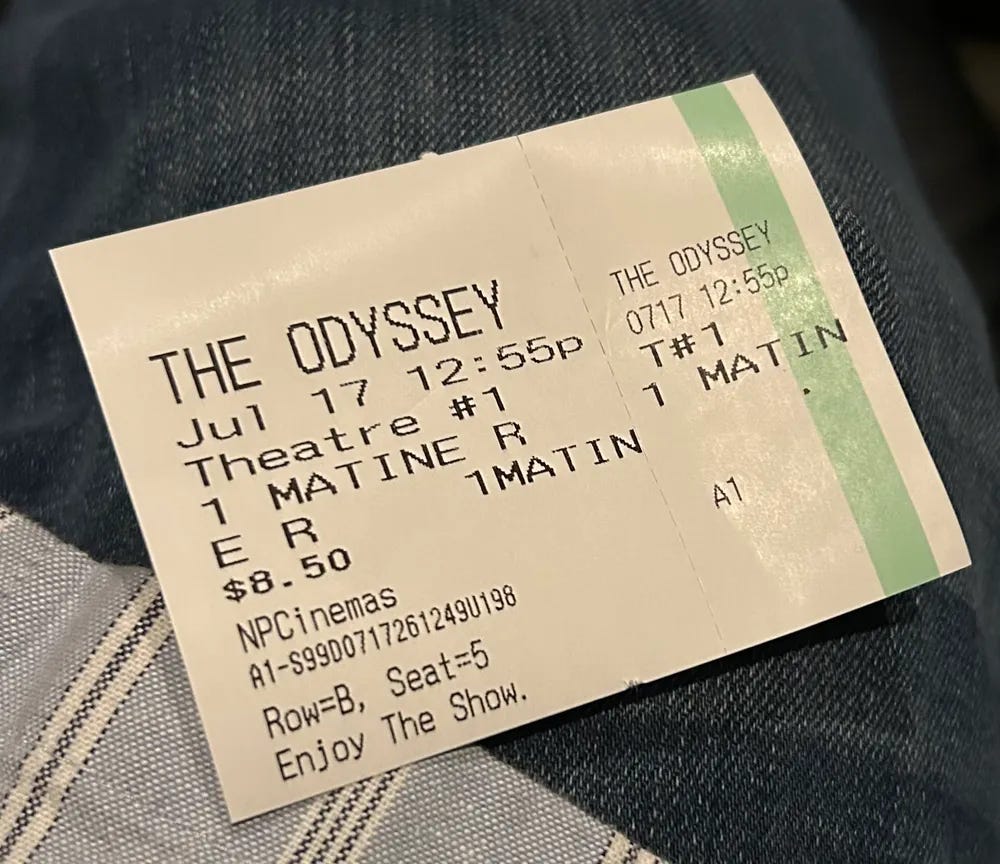
Most importantly: what is Nolan’s vision for the source material? What novel take would he bring to literally the oldest plot known to man? And: why did he feel the need to make The Odyssey now, at this moment in history? I was less excited about the movie as I was curious. Not wanting it spoiled, I went to the Friday matinee—the first available showing.
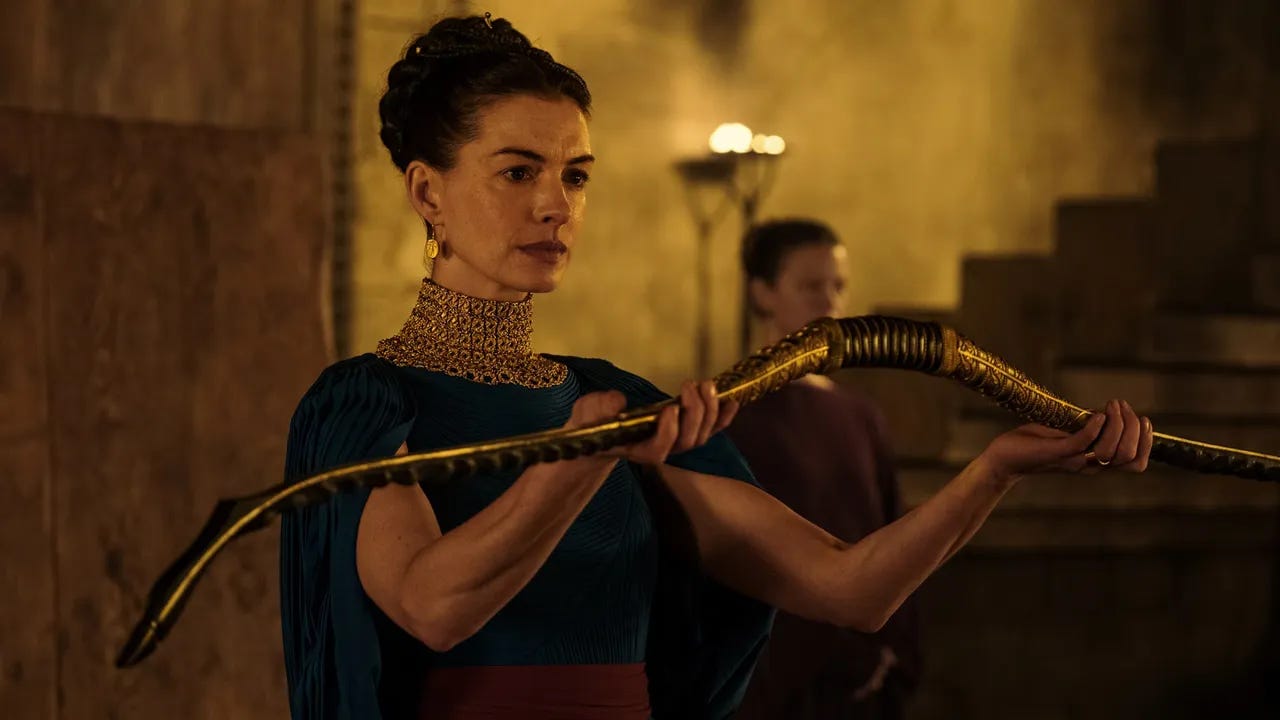
First things first: The Odyssey is a lights-out, unequivocal masterpiece. It’s so good, on so many levels. But Anne Hathaway is the highlight. She plays Penelope—Odysseus’s wife, the Queen of Ithaca, who works dutifully at her loom waiting for her long-lost husband to come home, as a throng of uncouth, cruel, Hegsethian suitors commandeer the palace, in the hopes of winning her hand once it is determined that Odysseus is dead. (Spoiler alert: Unlike Mitch McConnell, he is not.) There is none of the warm, chipper, happy-go-lucky Prada-Devil assistant here; it’s a dark part, and she plays it dark. It’s an exquisite performance.
As usual, I underestimated Matt Damon. Oppenheimer got its share of critical flowers, but as I’ve written here, it’s basically two Wikipedia pages in film form. The problem, I realized on Friday, is that Oppenheimer, the character, is kind of dull. Only when Matt Damon shows up does Oppenheimer pick up the pace and become entertaining. In The Odyssey, Nolan makes the wise decision to dispense with the dull centerpiece guy entirely and make the whole film about the Matt Damon character.
Odysseus is no physical marvel. He’s a soldier, so he’s not soft, but he’s an archer, not a swordsman. Damon is Jason Bourne fit, but, although he’s actually 5’10”, he looks smaller on screen—he’s literally a short king!—whereas Agamemnon, the King of Mycenae and the leader of the Greeks, is a veritable giant, imposing and terrible. In Troy as in the NBA: size matters.
As for Nolan’s novel take, his original vision? He simply makes the story as realistic as possible—and, given the inherent challenges of making a tale involving Cyclopses and Circean pigs realistic, he pulls it off beautifully.
In an early scene, Odysseus and Penelope are in bed, their toddler son Telemachus asleep nearby, and he is lamenting the fact that he has to leave to go to a war he doesn’t particularly want to fight in. The official reason Agamemnon summoned all the vassal kings to sack Troy is because the Trojans have kidnapped his brother Menelaus’s wife. That would be Helen, whose face, as Menelaus notes in the film, launched a thousand ships (even though those lines were written by another British Christopher, Marlowe, in 1604). Duty and honor demand that the Greeks assemble to bring her home.
But the great Mycenaean king, Odysseus tells Penelope, has an ulterior motive. “He wants to control the trade routes.” In other words, the Dardanelles that Troy sits upon are the Late Bronze Age Straits of Hormuz. All that sacrifice, all that bloodshed, all that destruction—all for a little more coin. So “dedicated” is Agamemnon to his imperial designs that he sacrifices his daughter, Iphigenia, to Artemis, for [checks notes] favorable winds. Yikes.
When I first read The Odyssey, I found the Penelope/Telemachus storyline dull. (I was too young to really get it). That’s not the case in the film. The father is gone and may never return; the mother is besieged like Troy itself by the same ilk of ruffians, and is holding out as long as she can; the son understands all of this, but is too raw and soft and young to do anything about it. No one takes him seriously. The kid needs to grow up, and grow up fast; if not, his mother will be taken by one of the odious suitors, and he, Telemachus, will surely be slain, so that the victor can assume the throne of Ithaca himself.
Those are the stakes.
Robert Pattinson, who plays the villainous lead suitor, Antinous, is not going to be denied. It is a delightfully “meta” moment when he contrives to be alone with Penelope, and tries to persuade her to abandon hope of Odysseus’s return and instead marry him; this is freakin’ Edward from Twilight, still one of the most attractive men alive, veritably catapulting pheromones at her; if she isn’t tempted by that, nothing will tempt her.
Agamemnon’s homecoming ends quickly and tragically—with his wife, Clytemnestra, murdering him, to avenge the sacrifice of their daughter to the gods. (In the mythology, Clytemnestra and Helen are half-sisters; in the film, they are twins, both played by Lupita Nyong’o—much to the dismay of MAGA nation, who cannot conceive of a Black woman’s face being worthy of launching even a couple of dinghies, let alone a thousand ships.) Hoping to avoid a similar fate, Odysseus, with the divine guidance of his patron Athene, returns to Ithaca in disguise as an old beggar, to assess the situation before he makes his move.
One of the weaknesses of Nolan as a filmmaker is that, as great as his movies are, they lack emotional wallop. He can be cold and dispassionate, and when I watch the films, I rarely respond emotionally to them. For example, in Oppenheimer, when the test bomb explodes successfully, we are supposed to be emotionally moved; I wasn’t. That weakness is not on display here. Whether it’s the sublimity of the source material, or simply, as one review has it, that Nolan has finally “learnt to write women,” there are a number of moving sequences in The Odyssey. The moment when Penelope realizes, beyond all doubt, that the beggar in her dining hall is indeed Odysseus is the single best part of the movie.
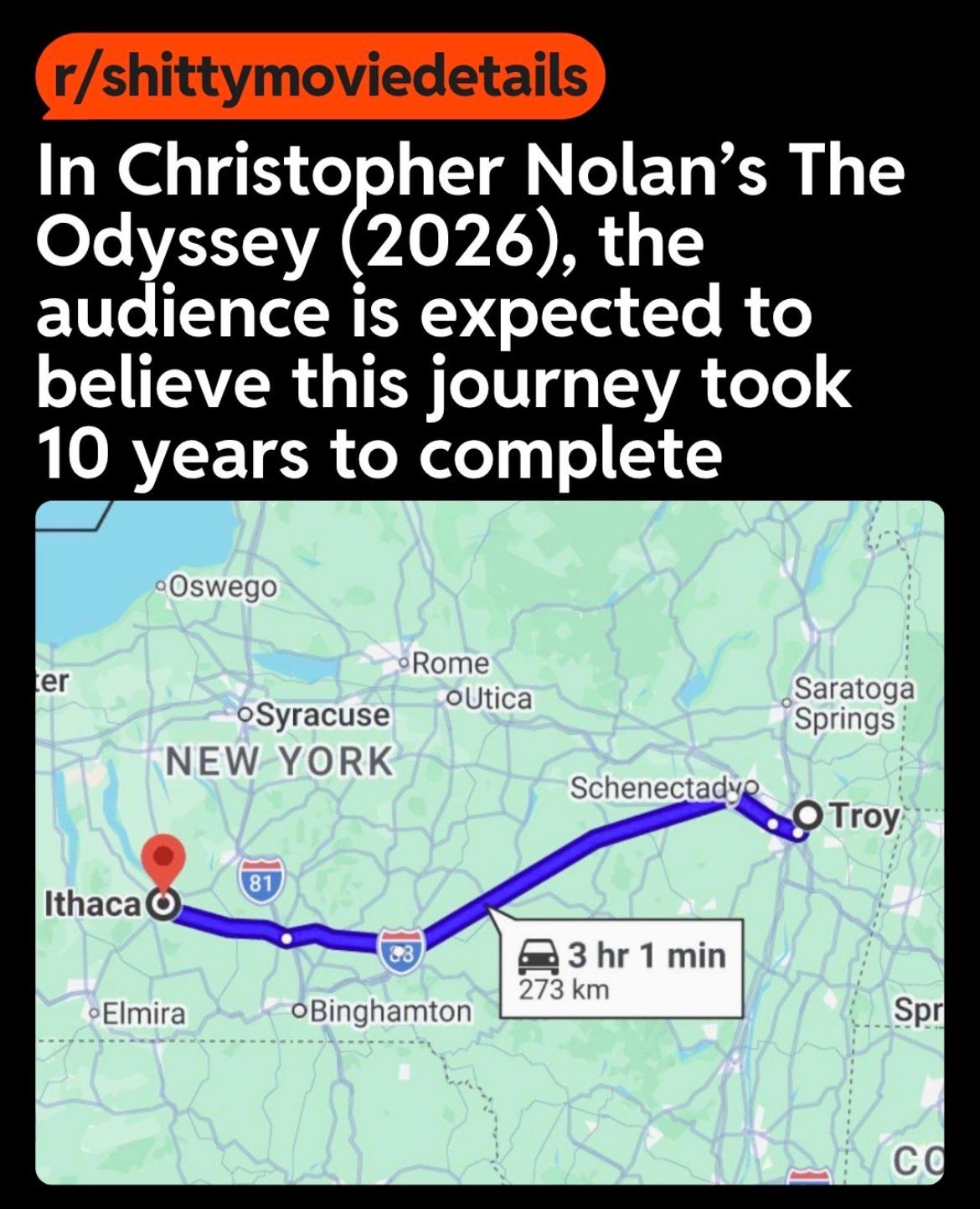
(The runtime, incidentally, is two hours 52 minutes, which is about as long as it takes a lead-footed New Yorker to drive from Troy to Ithaca.)
Nolan brings out the inherent feminist elements of The Odyssey. In Homer’s world, the women—whether they are gods or mortals—are more powerful than the men. Whatever Agamemnon’s ambitions, the impetus of the Trojan War is the kidnapping of Helen of Troy (which, if we believe the mythology, was itself the result of a squabble among the goddesses Athene, Aphrodite, and Hera). The suitors in the hall at Ithaca are intimidating dudes, but they would fight to the death to claim Penelope’s hand; she has enormous influence over them. It is a nymph, Calypso, who rescues Odysseus and nurses him back to physical health—and helps ease him back into reality. (My theory is that the reason Odysseus dilly-dallied on Calypso’s island for seven years is because that’s how long it took him to come up with a plausible excuse for why he remained “stranded” for so long with his gumad Charlize Theron.) Athene is the goddess that gives him protection. In Mycenae, mighty Agamemnon, the king of kings, is felled by his wife. And as to the epic’s other men? They are pigs—as Circe well knew.
Why did Nolan make this movie now, at this moment in history? J. Robert Oppenheimer and Odysseus have something in common: both used their superior intelligence to devise a way to sack a city and, in so doing, win a war. Both men had to live with the consequences of that: the guilt, the weight of the responsibility for the lost lives and the mindless destruction, the glory, the infamy—all of it. Oppenheimer and The Odyssey are both about brilliant, complicated men coming to terms with their pivotal roles in a great war.
There are several mentions in the film of the Sea People. To Penelope, they are terrifying heralds of what feels to her like the end of the world. Odysseus feels the dread, too. His stratagem, brilliant as it was, was a trick that took advantage of the honor of the Trojan people. It worked, yes; but it was a dick move. He violated Zeus’s Law, as he says in the film—and without that, what remains? In the final analysis, what was really won?
Assuming the sack of Troy was real, the Late Bronze Age Collapse happened so soon after the Trojan War that one can reasonably conclude that the latter somehow led to the former. Petty squabbles among the Greeks and Troy weakened all the kingdoms, leaving them vulnerable to invasion by the Sea Peoples—or so the film intimates. Does Nolan see a parallel between then and now?
Traditionally, this kind of epic is populated by characters with British accents. But Nolan—who was born in London and speaks with a British accent himself—made a different choice. The characters all talk like Americans—as if Troy and Ithaca were in Upstate New York and not the Aegean.
This serves two purposes. First, it makes it seem like these characters, for U.S. audiences at least, exist in the here and now, heightening the realism. Second, it equates the Mycenaean Greeks on the verge of the Late Bronze Age Collapse with the United States in A.D. 2026.
We don’t know what caused the Collapse. Probably it was the result of a number of factors that happened simultaneously: plague; famine brought on by climate change; needless wars over trade routes; alliances breaking down; income inequality exacerbated by a ruling oligarchy; bad leadership; and, maybe, the Sea Peoples. Whatever the cause, the Collapse was the end—not of the world, as Penelope feared, but certainly of a long and fruitful chapter of history.
With the looming stock market crash brought on by speculation in AI and data centers; the burning-of-Library-of-Alexandria-level destruction of our government’s investment in medical research; the fracturing of NATO; the avarice of Elon Musk, Peter Thiel, and the rest of the Epstein class; the irrevocable warming of the planet caused by manmade climate change; and the worst possible people governing the country, the end of our current chapter seems imminent.
How did we get here? How did it come to this?
Our enemies the Russians did not invade the United States. They were not strong enough to do so. Instead, they tricked the American electorate into installing a Kremlin stooge in the White House—not once, but twice.
Odysseus devised his famous stratagem three thousand years before the signing of the Declaration of Independence. Even those who haven’t heard of Homer, much less read his work, know of the trick. It’s been famous for thousands of years.
Trump may be more porcine than equine—a Circe product. Even so, after all this time, we should have been able to spot a Trojan horse.
ICYMI
Great show on Friday! Nadine Smith joined us on The Five 8—and me in my office.
Oh my, Greg. Wonderful again. Trojan horse indeed. I am not much of a moviegoer, to my detriment I am sure. I trust you so much I will go see The Odyssey—-and soon. I did see both Dunkirk and Oppenheimer, but I agree with you about the test scene in Oppenheimer. I expected to be moved emotionally, but was not. I love the Dunkirk story, and was strangely disappointed with the movie. I had a hard time keeping the characters straight and me emotionally invested. I guess I want movies with a heart and a soul and a connection in my own way.
I absolutely fear this is late Bronze Age today. Thanks for the connection. I was born in 1953 so have seen a lot with my own eyes, and I have awakened in shock every single day for ten years that we have chosen the end of expertise and decency and truth and humanity willingly and belligerently and angrily and happily. Make it make sense…………
Greg, many thanks. Mrs OM and I saw Nolan's Odyssey yesterday and like you found it amazing. I recently read a "Lunch with the FT" column that may give some insight into Nolan's treatment of women in the movie. Thought you might be interested in it.
"Emily Wilson, the acclaimed translator of Homer’s epics, is the professor of classical studies at the University of Pennsylvania and is something of a rock star in her field. A decade ago her editors warned that her translation of The Odyssey — the first by a woman in English verse — might struggle to sell. But it landed in 2017 with a thunderclap, celebrated for its pace, diamond-studded idiom, and most of all for bringing an overdue female sensibility to the ancient poem — a shift that provoked outrage from the nationalist right, which has long liked to see classical Greece and Rome as embodying a certain manly ideal.
The Hollywood director Christopher Nolan cites her version as influencing his forthcoming summer blockbuster." If interested I can try to send the entire interview. She soon will publish an updated translation.
We enjoyed Friday's Five & 8, Natalie's insights are always spot on. For those who find soccer boring, Saturday's England v France is a must see, the most fun ever in a match. The movie, Five & 8 and the game were much needed distractions from the shitstorm in the Middle East, as scary as the destruction of Troy in real time, a war where everybody loses. The demented oval inhabitant and his inebriated SecDef will create a dark period to rival that following the bronze age.