

Howard's End
The mendacious Commerce Secretary Howard Lutnick has proved a world-class liar. What else is he not being truthful about?
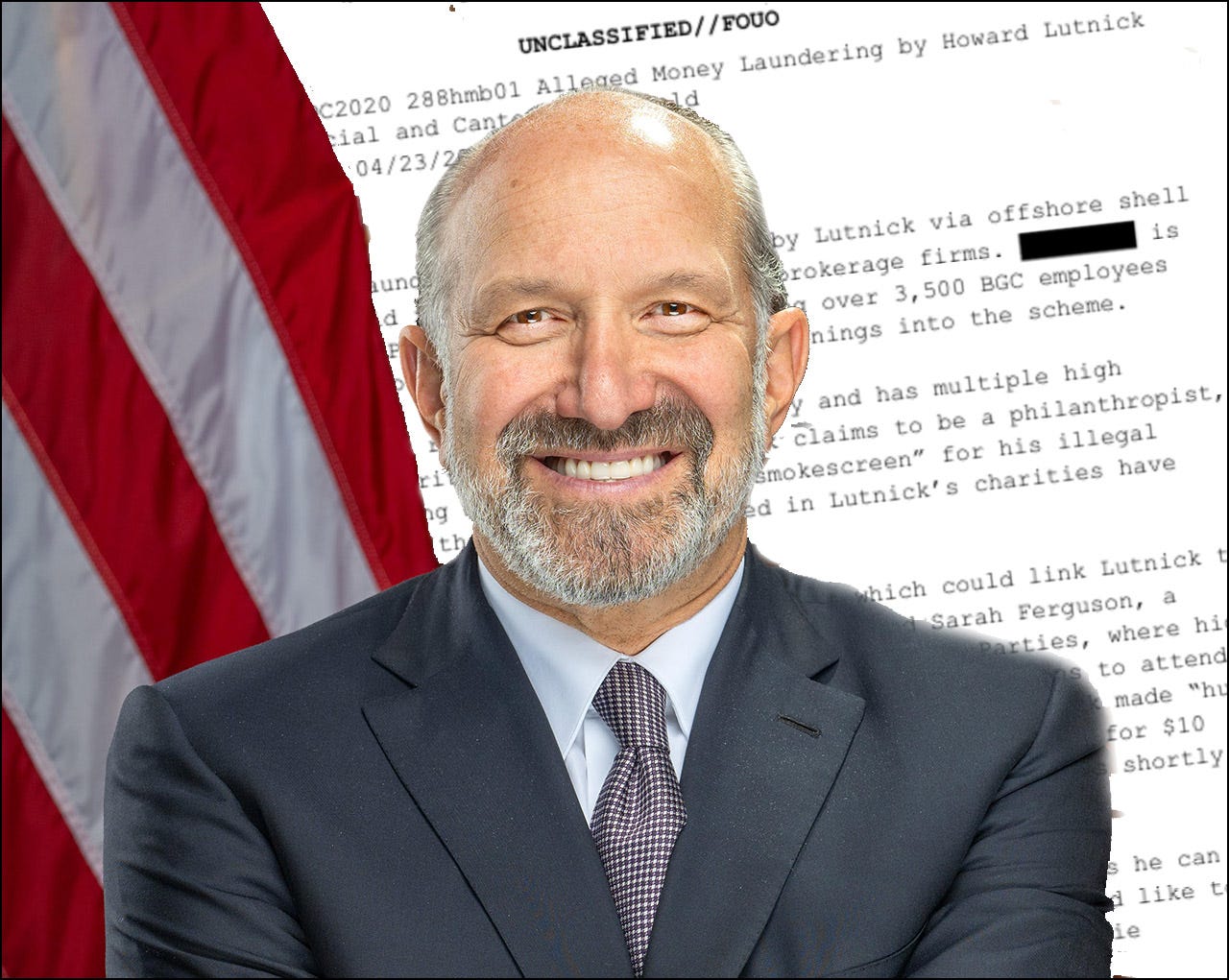
“If Trump saw value in dumping Howard and ending the Epstein noise, he’d do it. We’re just not there yet.”
—Former Trump campaign official to POLITICO, February 10, 2026
I. The Attacks
Although he’d been the head of the “very sharp-elbowed”1 financial services firm Cantor Fitzgerald since 1991, and a familiar figure on Wall Street for years before that, Howard Lutnick did not enter the wider public consciousness until September 11, 2001.
Certainly that’s the first time I’d heard of him. There was Lutnick on the news programs, with his receding hairline and puppy-dog brown eyes and reassuring Long Island accent, sharing his tale of unimaginable woe.
Cantor Fitzgerald occupied the 101-105th floors of One World Trade Center—six floors higher than where, at 8:46 am on the morning of 9/11, a hijacked American Airlines commercial flight smashed into the building. Six hundred fifty-eight of the company’s 960 employees died, including Lutnick’s brother, Gary. Only dumb luck had spared Lutnick—September 11, 2001, was his son Kyle’s first day of kindergarten at the exclusive Horace Mann School.
At a moment when the city was reeling, struggling to make sense of what’d just happened—the initial shock beginning to wear off, replaced by grief and anger and puzzlement and survivor’s guilt and mournfulness; but also, on the other hand, an overwhelming feeling of love and compassion and desire for communion I have not experienced before or since—Howard Lutnick gave voice to what many of us were feeling. He may have been a ruthless chief executive, a titan of Wall Street, but at the end of the day, he was a New Yorker, like the rest of us. His pain was our pain.
On September 13, 2001, Lutnick sat down for an emotional interview with Connie Chung. He cried a lot—who could blame him?—but he got through it.
This is what he said about his brother Gary’s horrible death:
My brother was on 103rd floor. He worked for me. He worked at Cantor. And he called my sister just after the plane hit and he told her that—he said that the smoke was pouring in. He was stuck in a corner office. There was no way out, and the smoke was coming in, and he’s—he’s not good, and things are not good, and he’s not gonna make it. And he just wanted to say that he loved her, and he wanted to say goodbye, and tell everyone that he loved them. And then the phone went dead. So while I’m the head of the company, I’m trying to help my 700 employees who are missing their loved ones, I’m just another one of them. Just another one of them.
“Normally,” Chung picked up the storyline, “you would’ve been in your office on…the 105th floor, and yet you didn’t go in early that morning because of a critical decision you made.” Lutnick took the cue:
My little boy—I have a five-year-old, and it was his first day of kindergarten at Horace Mann. So I took him for his first day of big-boy school. And because of that I was late getting down to the office, and therefore I wasn’t in the building. I was on my way to the building instead….
Lutnick went on:
I saw the building on fire, so I didn’t go in. But I stood—I stood at the door off of Church Street where they were flags there, and I stood at that door, and people were coming out, and I was yelling at them, you know, to run and get out. And there were police sort of around me, yelling at people, telling him to get out. And I would ask them what floor they were coming from, what floor they were coming from. Someone would say 55 and I’d scream, “We have 55!” Because I kept wanting to get up the building and get people out. Employees were on 101 to 105, the top floors of Number One World Trade Center, which they now call the North Tower, so how high was the highest number you got to. I got to the 91st floor, and I knew if I got one employee—that if one person came down from that floor, than I knew there had to be others—there would be others behind them. There will be others going out other doors, and that would be good.
But I got up to 91, and then I heard the sound. It sounded like another plane was going to hit the building, but it didn’t sound like it was far away, it sounded like it was right where the ceiling is above us. It was so unbelievably loud. Then someone screamed out, “Another one’s coming!” So I just turned around and ran. And I was running….
It was Number Two World Trade Center collapsing. So I’m standing underneath the building like an idiot. And I start running, and I’m trying to get ahead of the smoke. And then the smoke comes around the corner by Trinity Church, where I ran, knocks me down underneath the truck. And I’m sitting there in this black—the black is black that can ever be. I reached up. I tried to see if I could see. And I took my hand and I put it up and I actually touched my eye, because it was so much smoke, and I couldn’t even see my own hand. I couldn’t see my hand. I could feel the particles in the air, they were like this big. I could feel them going in. I wasn’t—I couldn’t think to like pick up my shirt and put—I was just sitting there thinking, “I can’t believe it. I can’t believe by standing there I died.” So I just start walking, I just start walking straight, I just walk straight, and I just keep walking straight.
And I called my wife four hours later. She was hysterical crying. And so I understood why it took lots of people a long time. I’m a pretty together person, and four hours, I walked. I just walked north. I just kept walking….
All of that resonated with New Yorkers—especially, for me, the part about the aimless walking. By 10 am on 9/11, everyone was out in the street on what was, weather-wise, an absolutely gorgeous late summer day. There was nothing to do but walk. People in lower Manhattan were scurrying uptown, away from Ground Zero, while people further uptown—like me, who watched on my boss’s TV at the AP’s offices at 50 Rock—were drawn downtown, to try and help. The bridges and tunnels were all closed. The subways didn’t run until later that afternoon. Cabs drove around in circles. It probably took my wife and I four hours to make it home to Astoria.
At the end of the interview, Lutnick beautifully articulated his compassion for his lost employees and their families:
I don’t know of a single one of my employees who got down [from the top of the tower]. Zero. Zero. And it’s really sad, but I think we’re all pulling together with the view—we want to make things happen for them. We need to take care of them. We need to figure out how to take care of them, and give them more. And take care of them. I think it’s gonna be a different kind of drive that I’ve ever had before. It’s not about… It’s not about my family. I get to kiss my kids. I get to kiss my kids tonight, but other people don’t get to kiss their kids, and I just have to help them.
And I think what’s amazing, and I think it’s amazing, there are 300 people, they lost all their friends; they lost a person to their left, they lost a person to their right, and they call me up, and they say, “I want to go to work.” I say, “Why do you want to go to work? Let’s just go to funerals.” They say, “No, no, I want to go to work. I can’t stay home. I can’t stay home. I have to work. I have to do something.” And so they actually wanted to try to figure out how to be in business. It’s unbelievable. It doesn’t make any sense, but the reason they want to be in business is because we have to make our company be able to take care of my 700 families. We have 700 families… I just can’t say it I can’t say without crying….
I just tell them, “Look, I’ll answer any question, any question you want about it, but I lost my brother, and I’m in no different position than you are. I’m not any different. I’ll just tell you everything I know.” But I get to say to everybody, so they believe me, that when I say we are doing everything we can to find their kid, but they know that I do not look for my brother. I wouldn’t go to any hospital or get anybody to go to any hospital and say, “Find Gary Lutnick for me.” Because I go with an employee list. I say, “Here’s my list of everybody I got. Find somebody on this list. I don’t care who they are.” If we find someone on this list, and then I get to call them, and I get to give somebody else some hope. Some dream. Maybe—maybe they get to kiss their kids. It’s… I’d love to find my brother. But I’d love to find their brother or their wife or their husband or anything. Anything.
And I watched that interview, and I thought, “Jesus. This poor guy. He’s heartbroken, he’s devastated—it’s written all over his face—but he’s doing all the right things. Good for him.”
After that, I didn’t think about Howard Lutnick for 25 years—until his old chum Donald Trump nominated him as Commerce Secretary.
II. The Files
Lutnick is now 64 years old. He’s grown a beard, which neatly offsets the receding hairline, and the streaks of gray in his salt-and-pepper hair become him; he looks more distinguished now, professorial. Financially, he’s done very well for himself. He has a personal net worth of $3,000,000,000—give or take a few million. And he still speaks in the affable, heart-on-his-sleeve manner I remember from the Connie Chung interview.
Only now, we know that he’s a world-class gaslighter. If lying were an Olympic sport, he’d be partying with Kash Patel in Milan. Even in a West Wing ensemble that includes some of the most shameless, fork-tongued liars on the planet, Lutnick stands apart; he is the Meryl Streep of mendacity.
Case in point: In October of last year, Lutnick told Miranda Devine of the New York Post, on her “Pod Force One” podcast, about his first visit to the home of his next-door neighbor, Jeffrey Epstein—from whom he’d (indirectly) purchased his stately manse (of which, more later).
This made headlines for an anecdote he shared, which struck me in the moment as a story Lutnick’d told many times and delights in telling. Here is the Post’s synopsis:
The 64-year-old cabinet secretary said Epstein himself showed off his notorious “massage room” while giving Lutnick and his wife a tour of the infamous East 71st Street townhouse after the couple moved in next door to the since-disgraced financier in 2005.
“I say to him, ‘Massage table in the middle of your house? How often do you have a massage?’” Lutnick recalled. “And he says, ‘Every day.’ And then he gets, like weirdly close to me, and he says, ‘And the right kind of massage.’”
Lutnick said he and his wife quickly excused themselves and left Epstein’s home, “and in the six to eight steps it takes to get from his house to my house, my wife and I decided that I will never be in the room with that disgusting person ever again.”
When asked by Devine whether Epstein’s rich and powerful associates—including the likes of Prince Andrew and Microsoft founder Bill Gates—“could hang around him and not see what you saw, or did they see it and ignore it,” Lutnick responded, “They participated.”
“They get a massage, that’s what his MO was. ‘Get a massage, get a massage,’ and what happened in that massage room, I assume, was on video,” the commerce secretary went on. “This guy was the greatest blackmailer ever, blackmailed people. That’s how he had money.”
Again, Lutnick seemed completely sincere in that interview—and especially convincing because, in bringing up the subject of Epstein at all, he appeared to be touching the third rail of the Trump White House.
The thing is, that story? It’s complete horseshit. He and his wife, Allison Lutnick, were so put out by that “disgusting man” that they [checks notes] visited the creepy pedo on his private Caribbean rape island.

And as I’m hardly the first to point out, Howard and Allison Lutnick both mention the ages—and in her case the genders—of the various children to this notorious child sex trafficker, whom Lutnick claimed to have repudiated years earlier.
Huh.

When asked about this discrepancy during a recent Senate Appropriations subcommittee hearing, Lutnick copped to “probably about 10 emails connecting me with [Epstein] over a 14-year period. I did not have any relationship with him. I barely had anything to do with that person, okay?”
“That person”—whom he addressed, in those emails, familiarly, as “Jeff.”
Lutnick added, for good measure, “My wife was with me, as were my four children and nannies. I had another couple… they were there as well with their children, and we had lunch on the island…for an hour. Then we left with all of my children, with my nannies and my wife, all together. We were on a family vacation. We were not apart.”
One last time, for the people in the back: “The only thing that I saw with my wife and my children and the other couple and their children was staff who worked for Mr. Epstein on that island.”
The word “staff” is doing a lot of heavy lifting in that sentence, but even so, that’s almost certainly the truth.
But at this point, after a full year of rapid-fire lies, why should we believe a word Howard Lutnick says? Especially when, as Jamie Bonkiewicz pointed out on X, one of the creepy rubber masks that Epstein had decorating the sterile walls in what appeared to be a dental room of his compound on Little St. James bears a striking resemblance to a certain Commerce Secretary:
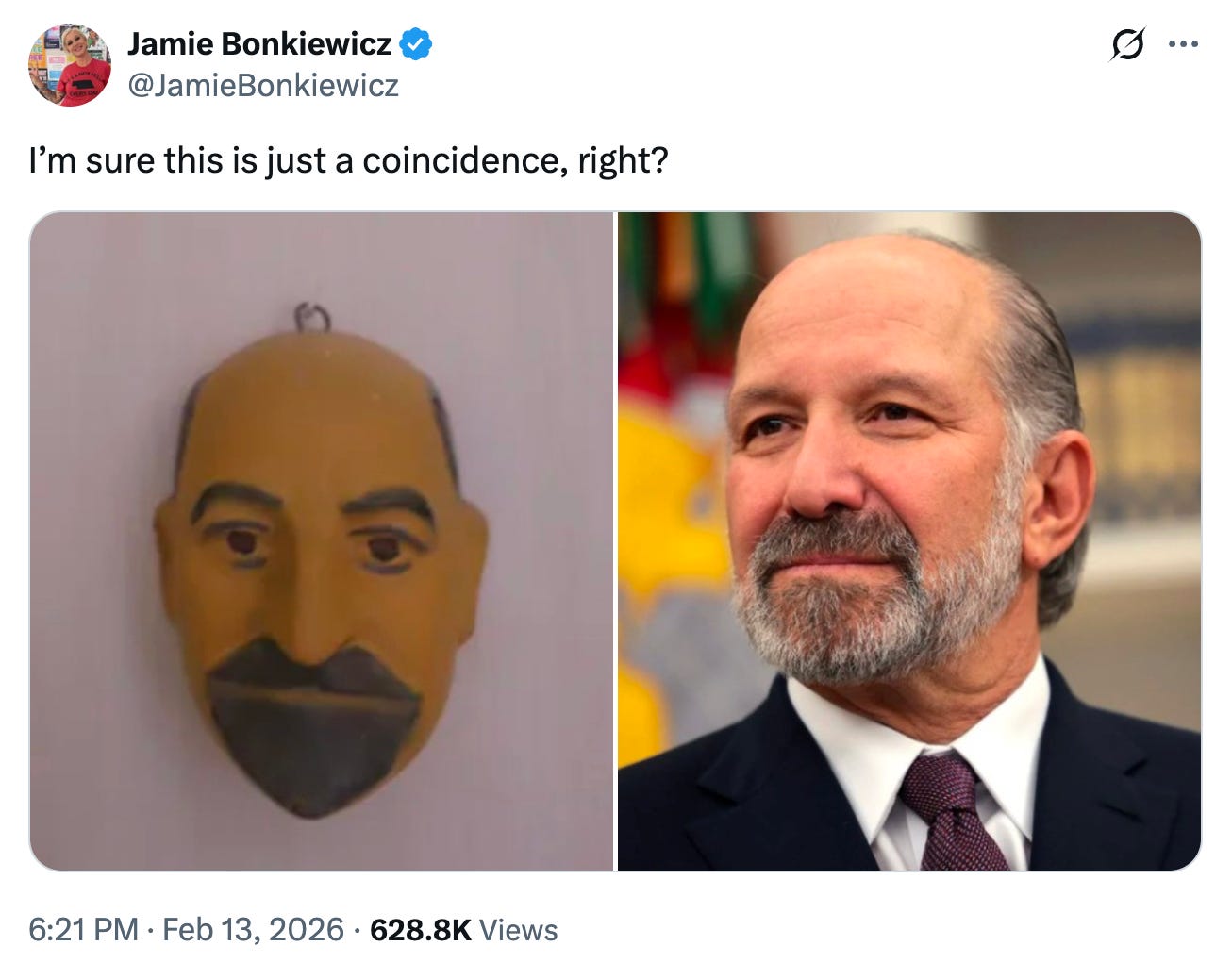
Does that prove anything? No. But it’s not a good look for Lutnick.
III. The Aftermath
On December 10, 2001, the features writer Meryl Gordon, who is a professor of journalism at NYU, wrote a profile of Lutnick for New York magazine. The Cantor Fitzgerald CEO had had an eventful, up-and-down three months, punctuated by his ill-fated decision on September 15—less than a week after the attacks—to suspend the direct deposits of his still-missing-and-presumed-dead employees. You know, the ones he’d wept for so passionately on TV literally two days earlier.
Gordon writes:
Who is Howard Lutnick and what is his greater purpose? These questions are part of our public need, both empathetic and voyeuristic, to plumb the depths of his company’s tragedy. For Lutnick embodies much about New Yorkers on September 11. He started that day a Wall Street buccaneer, a hugely successful, legendarily aggressive striver who was personally worth as much as a half-billion dollars. By the 13th, he’d become the accidental survivor who was crying on Connie Chung about how it felt to lose so many people and to run for his life. By the 15th, he was the Dickensian villain who’d cut off the widow’s mite, the paychecks of the dead, to assure the bankers of his sangfroid. By October 10, he had announced a munificent and detailed financial plan for the families. By then, not many people knew what to believe about Howard Lutnick.
That remains true. There was then, and is still, something Jekyll-and-Hyde about Howard Lutnick. With this guy, we get the full spectrum—all 88 piano keys. He can project deep empathy and compassion…while at the same time gaslighting the American people on behalf of some of the worst humans to ever walk the earth. As Gordon put it, 25 years ago,
All the elements of his personality are out there: He’s likable, he’s irritating, he’s furious that his motives are being challenged, he pushes people hard but then teases them, he’s smart and self-aware yet also in denial. “It’s not sad here. It’s not sad here. It’s not sad here,” he insists of his current workplace, a remark that makes his co-workers affectionately roll their eyes. But in the next moment, he’s overcome by sadness. He’s a man who keeps going forward because forward is the only direction open to him.
What to make of this now, a quarter century later?
It is true that Lutnick continued to call and visit the families of his employees who died that day. It’s true that, as Gordon reported, “Lutnick’s financial package [for the families] is relatively good: ten years of health insurance rather than five; a share of 25 percent of the partners’ profits over a five-year period—a total package worth at least $100,000 per family.” It’s true that he set up and endowed a charitable foundation—the Cantor Fitzgerald Relief Fund—and put his sister in charge of it.
It is also true that on Lutnick’s watch, Cantor Fitzgerald sued American Airlines for negligence—because on 9/11, AA failed to [checks notes] prevent its plane from being hijacked. Which seems, to me, like a dick move.
Dick move or not, Cantor won a $135 million settlement from AA in December 2013. The lion’s share went to the firm’s partners. As best as anyone can tell, no one pocketed more of the settlement money than Howard Lutnick. As Fox News reported at the time:
Speculation in the firm suggests Lutnick took anywhere from $15 million to $25 million from the settlement. A spokeswoman for Cantor would not deny he was entitled to receive millions of dollars, and neither she nor Lutnick would deny the speculated amount.
“All of the money for the business interruption recovery relating to the American Airlines case went either to strengthen and support the overall business, or to the over 600 Cantor Partners, precisely proportionate with the exact stake in the company, Mr. Lutnick included,” the spokeswoman said. “For five years, Cantor’s Partners provided 25% of the firm’s profits to the 9/11 families, a total of at least $180 million, in addition to ten years of health benefits.”
Lutnick declined to comment.
A senior executive at Cantor said the manner in which the settlement was distributed, including the chunk of money Lutnick received, is entirely appropriate since Cantor never promised family victims a portion of the money in the first place. The executive described the case against American Airlines as a “business interruption lawsuit” since Cantor’s offices were destroyed in the attack, meaning it was appropriate for the company to keep the money.
Both Lutnick’s decisions to halt the missing employees’ paychecks and to pocket so much of the AA settlement money remain a sore subject for many of the Cantor Fitzgerald 9/11 families. And it leaves the rest of us scratching our heads.
How can one man be Ebenezer Scrooge before the ghosts visit and Ebenezer Scrooge after the ghosts visit, simultaneously?
IV. The Allegations
» Old Stuff
Founded by Bernie Cantor after the Second World War, Cantor Fitzgerald acquired a reputation as a shady firm when Howard Lutnick was still in diapers. As the New York Times explains:
At first, the firm designed sophisticated tax strategies for Hollywood stars like Kirk Douglas, Zsa Zsa Gabor and Clint Eastwood. Later, Mr. Cantor’s clients included Meshulam Riklis and other brash conglomerate-builders of the 1960’s….
As far back as 1974, Cantor Fitzgerald paid $265,000—a substantial amount in that era—to settle an S.E.C. case charging that it had participated in a scheme that defrauded investors of $9 million through a mutual fund. The firm denied wrongdoing, saying it settled the case to avoid the expense of litigation.
Lutnick charted a similarly sketchy course after taking the helm:
The firm, without admitting or denying wrongdoing, was disciplined by the Securities and Exchange Commission in 1994 for record-keeping violations in connection with investigations stemming from the Treasury auction scandal at Salomon Brothers. And Mr. Cantor raised some eyebrows by hiring Peter DaPuzzo, who in June 1992 had paid $100,000 and agreed to a brief suspension to settle a New York Stock Exchange complaint arising from the manipulation of the price of Conagra shares in 1990 while he was at Shearson Lehman Brothers. Mr. DaPuzzo neither admitted nor denied any wrongdoing.
More recently, one of Cantor’s subsidiaries, Cantor Gaming, “entered into a non-prosecution agreement and agreed to pay $16.5 million in penalties and forfeiture to the federal government to resolve a criminal investigation into the company’s past involvement in illegal gambling and money laundering schemes.” In that scheme, one of the firm’s employees, Michael Colbert, pleaded guilty and went to prison.
And last year, the firm’s Irish subsidiary ran afoul of European regulations and was fined by the Central Bank of Ireland:
Cantor failed on a number of occasions to report identified suspicious transactions that may have indicated market abuse to the Central Bank. Cantor failed to put in place effective governance arrangements to detect and report suspicious orders and transactions that may have indicated market abuse. Cantor also failed to consistently document its analysis as to whether it considered certain orders and transactions to be suspicious and failed to consistently escalate suspicious transactions internally – during a period of over 6 years between March 2017 and June 2023. Cantor has admitted to the breach.
In the grand playing-in-the-gray scheme of Wall Street things, all of that is small potatoes, to be fair.
But the sins of Cantor Fitzgerald past pale in comparison to the new disclosures in the Epstein Files—allegations that Lutnick was personally working with Jeffrey Epstein, laundering money for the Russian mafia.
» Whistleblower
The whistleblower—his name is redacted, but let’s call him Mr. Simons—was a former employee of Cantor Fitzgerald and BGC Financial, a subsidiary of Cantor that provides voice and brokerage services (“BGC” stands for Bernie Gerald Cantor, the parent company’s founder). He held a Series 30 license and was the head of a division that handled regulatory compliance. If Mr. Simons is who I believe he is, he’s still very active in the financial services industry, the head of a boutique firm. In short, he’s not some crackpot.
On two separate occasions, Mr. Simons contacted the FBI to report shady shit. In October of 2020, he called the Bureau’s tip line and told the feds that he’d “uncovered fraud, money laundering, Ponzi schemes, and regulatory breaches by [BGC] and CF, so he became a whistleblower. [BGC] and CF received large fines and there are ‘live cases’ still occurring in the United Kingdom.” This is according to the FBI’s Guardian Complaint Form, headlined “Alleged Money Laundering by Howard Lutnick via BGC Financial and Cantor Fitzgerald.”
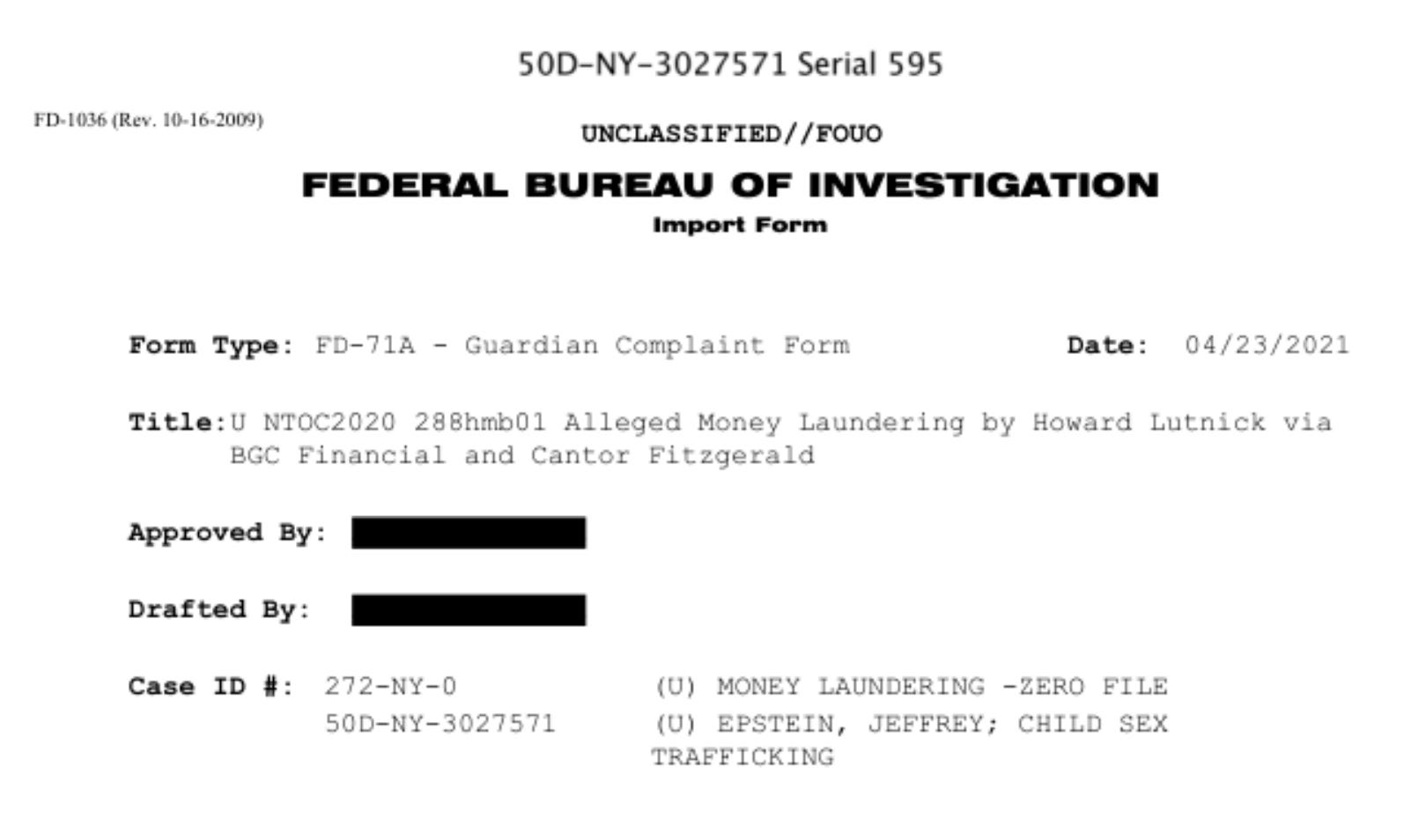
The document continues:
Further investigation by [Mr. Simons] linked Howard Lutnick to illegal activities with JP Morgan, Russian Hedge Funds, and other senior executives in the financial business.
[Mr. Simons] has documented proof showing money laundering and Ponzi schemes by Lutnick via offshore shell companies, liquid funding, and real estate brokerage firms. [BGC] is using a “global Ponzi share” scheme involving over 3,500 BGC employees who are forced to contribute 10% of their earnings into the scheme.
Liquid Funding is the name of Jeffrey Epstein’s primary offshore company—which the FBI officer writing up the report seems not to have known; hence the lowercase letters.
Lutnick is deeply rooted to the royal family and has multiple high profile and celebrity connections. Lutnick claims to be a philanthropist, but is merely using his charities as a “smokescreen” for his illegal activity. Many of the individual involved in Lutnick’s charities have criminal breaches against them.
[Mr. Simons] believes he has supporting documents which could link Lutnick to Jeffrey Epstein and Ghislaine Maxwell. Maxwell and Sarah Ferguson, a royal family member, host events called La Dolce Vita Parties, where high profile celebrities and executives contribute large donations to attend. The donations are linked to causes involving children. Lutnick made “huge donations” to these events. Epstein also sold Lutnick a house for $10 dollars through a trust fund, which was then sold for millions shortly after prior to the money going overseas.
The part about the house being sold for ten bucks is, technically, true. But it’s not as red-flaggy as it seems, as Crain’s explains:
In 1992 Sam Conversion Corp. sold 11 E. 71st St. [Lutnick’s house, next door to Epstein’s at 9 E. 71st St.] to the 11 East 71st Street Trust for “ten dollars and other valuable consideration paid by the party of the second part,” records show. Martha Stark, former commissioner of the city Department of Finance, told Crain’s that the $10 figure is a placeholder used in many real estate sales—a holdover from a period when the value of property transactions was not publicly disclosed.
The available materials do not show whether the two corporations exchanged any larger sum. But the sale documents identify Epstein as the vice president of Sam Conversion Corp. and a trustee of the 11 East 71st Street Trust, and both entities used the same Columbus address linked to [Les] Wexner. Wexner did not respond to a Crain’s query about his stake in either the corporation or the trust.
Four years later the 11 East 71st Street Trust—still with Epstein listed as trustee—sold the property to the Comet Trust, again for “10 dollars and other valuable consideration.” Unlike the previous deed transfers, this one makes note of the real estate transfer tax paid on the sale: $86,800. From this, Stark extrapolated the true sale price was $6.2 million….
In 1998 Comet Trust sold 11 E. 71st St. to Lutnick, again for “10 dollars and other valuable consideration.” The real estate transfer tax payment came to $106,400, from which Stark estimated the actual price to have been $7.6 million.
On the very day of the sale, Lutnick took out a $4 million mortgage on his stately new manse. You know, as one does.
But back to the whistleblower complaint.
When the FBI officer who wrote up the Mr. Simons report ran it through the Bureau’s Sentinel and Guardian databases, he found “26 results in the NY division case files including restricted closed case no.:272D-NY306108, Serial 204, concerning money laundering and control file case no.:194-NY-C277070-B, Serial 392, concerning a RICO violations/real estate scheme.”
Curiously, the officer notes that “[q]ueries were not conducted on Epstein and Maxwell due to the sensitive nature of the case.” Huh.

A follow-up 302 report was filed three months later. In that document, Mr. Simons elaborates on his allegations, claiming that BGC Financial and Cantor were
well known for money laundering. CANTOR FITZGERALD had a history of crime. Senior officials have spoken about [how] the money laundering occurred. PARABRIDGE INTERNATIONAL SERVICES (PIS) was an affiliate of [REDACTED FIRM] and CANTOR FITZGERALD. PIS was where payroll passed through in addition to the money raised on charity days. They were part of the compliance division. [Mr. Simons] thought there were illegal wire transfers involving PIS. PIS was associated with DEUTSCHE BANK accounts in Singapore and Hong Kong. CANTOR FITZGERALD was paying brokers from foundations in other countries through PIS. PIS had hired an ex DEUTSCHE BANK CEO as Global President. The Panama Papers connected CANTOR FITZGERALD to shell companies.
I have found nothing whatsoever on Parabridge. Every search brings up only the FBI documents.
HOWARD LUTNICK (LUTNICK) ran everything and he maintained a very small circle. LUTNICK instructed all of the fraud being committed. He used philanthropy as a smokescreen for illegal activity. CANTOR FITZGERALD was not doing well pre-9/11. After the events of September 11, 2001, CANTOR FITZGERALD was doing well. CANTOR FITZGERALD couldn’t afford people’s salaries and then was able to hire people and give people opportunities.
CANTOR FITZGERALD ran a global charity day in New York and London. They invited high profile celebrities to come in and join staff on the trading floor for the day. The charity day revenue was raised through the trades placed that day and employees gave up their salaries for the day. Brokers are paid on commission, and [Mr. Simons] advised if CANTOR FITZGERALD was stealing the entire global revenues for the charity day, brokers couldn’t earn their commission, even if they did not participate in the charity day. Charity days raised $9-10 million each year, and [Mr. Simons] thought it was strange it raised nearly the same amount every year. Brokers were not given tax relief for the loss of revenue on charity days.
PIS handled all the funds raised in the United Kingdom on charity days and the associated wire transfers. [Mr. Simons] advised the day of the charity day trading would shift if the publicized day was not a successful trading day.
The allegations of charity fraud seem specific enough to warrant further investigation. Then there’s the dodgy real estate deal, which we’ve already covered:
LUTNICK was a neighbor of JEFFREY EPSTEIN (EPSTEIN) in the adjoining property at 11 E 71st Street, New York, New York. LUTNICK bought the property for $10 through a trust. LES WEXNER (WEXNER) and EPSTEIN owned the building. LUTNICK bought it in a very roundabout way from EPSTEIN.
We should note that, while it’s now common knowledge that Epstein and Lutnick were neighbors, that wasn’t the case five years ago, when this report was filed. The bit about Wexner’s apparent involvement, distant as it was, also seems to be right on the money.
[Mr. Simons] advised there was a relationship between LIQUID FUNDING and executives at BEAR STERNS. When BEAR STERNS collapsed, the executives moved to [REDACTED COMPANY] or they went to a Russian hedge fund.
This part is absolutely true; the “relationship” between the two was Jeffrey Epstein himself.
BGC INTERNATIONAL was involved in crime and money laundering. BEAR STERNS had hundreds of subsidiaries in 2018. BGC INTERNATIONAL was the parent company of many of these subsidiaries to include JP MORGAN CHASE and BLACKROCK. BGC PARTNERS made subsidiaries all over the world to include Delaware, Cyprus, and Malta. BGC INTERNATIONAL used many of the same intermediaries as INTER JURA, which was associated with PAUL MANAFORT. RENAISSANCE CAPITAL was another company they were associated with.
It tracks that JP Morgan Chase would have been involved in Epstein’s shady financial dealings; their Number Two, Jes Staley, was one of Epstein’s closest associates, and we already know about the $1 billion-plus in suspicious transactions the bank filed after Epstein’s death. (Renaissance Capital is owned by Robert Mercer, a prominent Trumpworld figure in 2016, but someone we haven’t heard boo from in quite some time.)


Mr. Simons “thought the money being laundered through CANTOR FITZGERALD and BGC INTERNATIONAL was from the Russian Mafia. That was what senior people in the trading market thought.”
The senior people, in my experience, are usually right.
It could also have been money made by CANTOR FITZGERALD through the frauds they were committing. AUBIN SECURITIES was associated with banned Russian entities.
Christopher Aubin was charged by the SEC last year of stealing money from his company’s investors.
LUTNICK gave SARAH FERGUSON (FERGUSON) office space above CANTOR FITZGERLAD [sic] in New York for the CHILDREN IN CRISIS (CIC) charity. GHISLAINE MAXWELL (MAXWELL) and FERGUSON would attend Dolce Vita Parties which raised money for CIC and STOW SCHOOL. CIC no longer existed.
Sarah Ferguson, of course, is the former wife of the former Prince Andrew.
There’s a lot there to unpack. None of it strikes me as implausible. And it is unclear if the FBI followed up with any of this.
» SPAC-man
In December 2024, Cantor paid a $6.75 million civil penalty to settle charges by the Securities and Exchange Commission that the firm caused “two special purpose acquisition companies (SPACs) that it controlled to make misleading statements to investors ahead of their initial public offerings (IPOs).” SPACs seem to be the prevailing vehicle of choice for sneaky wealth managers to move money around. Epstein was certainly aware of them. I regard any mention of SPACs with suspicion.
Perhaps the proximity between the announcement of Lutnick’s Cabinet selection (November 14, 2024) and of his company’s SEC’s charges and settlement (December 12, 2014) might provide clues to some questions that, in my mind, remain unanswered:
Why did Trump choose Lutnick? And: why would Lutnick, a 64-year-old billionaire CEO of a major financial firm, even want to be Commerce Secretary? Doesn’t that seem like a demotion? Like, how many Secretaries of Commerce can you name? Why is he here at all?
Or, as Meryl Gordon wondered back in December 2001: Who is Howard Lutnick and what is his greater purpose?
V. The Conspiracy Theories
There’s a lot of disinformation circulating on social media about Howard Lutnick. I’d like to address some of that now, to debunk certain sticky conspiracy theories that, ultimately, only serve to obfuscate the truth.
» Dumb Luck
I have been unable to confirm that the first day of kindergarten at Horace Mann in 2001 was September 11th, as Lutnick claims. Sometimes kindergarten starts later than the other grades, to ease the little ones into the routine; that may have been the case here. Also, even if the official start date was earlier, September 11th may have been Lutnick’s son’s first day of “big boy school.” Furthermore, Lutnick announced to the world why he was late on Connie Chung; if he were lying about that, one of the disgruntled Cantor widows would likely have called him out by now.
Edie Lutnick, Howard’s older sister, is an attorney who in 2001 maintained an office on the 101st floor of the World Trade Center. She, like Howard, was not yet in the office when the attacks happened, because her first client that morning rescheduled the appointment. This seems fishy at first blush. But remember, it was at 8:46 am when the first plane hit; a lot of people all across the city were not yet in their offices at a quarter to nine, myself included. If the attacks happened half an hour later, exponentially more people would have been killed. Nothing about Edie’s activities and behavior since 9/11 suggests anything suspicious; quite the contrary.
» Put Options
A number of “put options” were placed on United Airlines and American Airlines stock in the weeks leading up to September 11, 2001. The final 9/11 Committee Report addresses this in footnote #130:
Highly publicized allegations of insider trading in advance of 9/11 generally rest on reports of unusual pre-9/11 trading activity in companies whose stock plummeted after the attacks. Some unusual trading did in fact occur, but each such trade proved to have an innocuous explanation. For example, the volume of put options— investments that pay off only when a stock drops in price—surged in the parent companies of United Airlines on September 6 and American Airlines on September 10—highly suspicious trading on its face. Yet, further investigation has revealed that the trading had no connection with 9/11. A single U.S.-based institutional investor with no conceivable ties to al Qaeda purchased 95 percent of the UAL puts on September 6 as part of a trading strategy that also included buying 115,000 shares of American on September 10. Similarly, much of the seemingly suspicious trading in American on September 10 was traced to a specific U.S.-based options trading newsletter, faxed to its subscribers on Sunday, September 9, which recommended these trades. These examples typify the evidence examined by the investigation. The SEC and the FBI, aided by other agencies and the securities industry, devoted enormous resources to investigating this issue, including securing the cooperation of many foreign governments. These investigators have found that the apparently suspicious consistently proved innocuous.
The Securities and Exchange Commission, working with the FBI and other government agencies, conducted what we’re told was a thorough investigation on the matter, tracking down and interviewing the individuals who made the big trades. This is from the SECs supplemental report:
With respect to options trading, Table 1 sets forth the volume of contracts traded in UAL and AMR during the period August 20, 2001 through September 10, 2001.

An investment adviser registered with the Commission and based in the United States purchased 2,000 UAL October 30 put options on September 6. That trade constituted 96 percent of UAL put option volume for the day.
We interviewed both the CEO of the adviser and the trader who executed the transaction. [Note: the FBI also interviewed these two.] We also reviewed account statements for the adviser. Both the CEO and the trader stated that they manage several hedge funds and have a total of $5.3 billion under management. Both also stated that they make the investment decisions for the accounts they advise (and that they do not accept client recommendations. They said the 2,000 contract purchase was part of a series of transactions they had effected in airline related securities. They were bearish on the airline industry due to several factors, including recently released on-time departure figures, which suggested planes were not carrying as many passengers, and recently disclosed news by AMR reflecting poor fundamentals.
As part of its strategy, the adviser sold short 1,800 shares of AMR, 8,700 shares of Continental Airlines, and 18,500 shares of Delta Airlines on September 6. The adviser sold short an additional 3,800 shares of Delta on September 7 and 10, and 500 shares of Northwest Airlines on September 10. On September 10, it purchased 115,000 shares of AMR, believing the price reflected recently released financial information and sold short 117,000 shares of UAL.
The SEC report identifies the Goldman Sachs employee—the “influential airline industry analyst [who] lowered his earnings estimates for several major airlines” five days before the attacks—as one Glenn Engel, but does not disclose the names of the “CEO of the adviser and the trader” who purchased the put options. That’s a little bit sus, for sure, but it might just be that Engel gave the SEC permission to be named and the others did not.
In any case, the CEO is not Howard Lutnick. Cantor Fitzgerald did not “manage several hedge funds” or “have a total of $5.3 billion under management” in 2001; although it has since expanded its suite of services, at that time the firm dealt primarily in government securities. If there’s compelling evidence that Lutnick purchased put options on the two airlines, I have yet to see it.
Tellingly, Mr. Simons, the whistleblower, accused Lutnick of all manner of financial misdeeds—but says nothing about pre-9/11 put options. That the “put options” narrative is being amplified by RT, the Russian state news service, is further indication that there is no there there.
» Tariff Windfall
Contrary to popular—and my own—belief, Cantor Fitzgerald is not poised to make bank from the Supreme Court’s ruling torpedoing Trump’s unilateral imposition of tariffs. Semafore’s Liz Hoffman explains the confusion:
Wired reported in July that Cantor was among the Wall Street firms pitching a financial product tied to the outcome of the Supreme Court case. It cited an email sent by a Cantor salesman that said the firm had “already put a trade through representing about ~$10 million” of tariff-refund rights “and anticipate[s] that number will balloon in the coming weeks.” Two Democratic senators called for an investigation and the CEO of one of the country’s largest import-logistics firms amplified the story….
Cantor did consider the product—which has existed for years and was a humming trade on Wall Street during Trump’s first-term tariff push—but decided against it after weighing the political sensitivities, according to a senior banker familiar with the matter.
A Cantor spokesman said the salesman “erroneously” believed that the firm was likely to greenlight the business, then went out looking for the other side of the trade. “Cantor Fitzgerald has never executed any transactions or taken risk on the legality of tariffs,” he said. “Any report suggesting otherwise is completely false.”
This doesn’t mean the firm now run by Lutnick’s sons hasn’t profited bigly during the Trump Redux. Indeed, in 2025, Cantor Fitzgerald generated over a billion dollars in revenue—its best year ever. This isn’t just dumb luck; as Hoffman writes,
Cantor has clearly benefitted from its ties to Lutnick, becoming a big underwriter of deals aligned with the administration’s crypto, AI, energy, and national security agenda. As the lead banker to, and investor in, stablecoin company Tether, it holds billions of dollars of Treasury bonds, which has brought criticism from Bill Ackman and others about a conflict of interest. (Trump’s pressure on the Federal Reserve to cut interest rates would make existing bonds more valuable.)
And maybe I’ve answered my own question about why Lutnick wanted the job.
To paraphrase Mel Brooks: It’s good to be the Commerce Secretary.
VI. The Silence of the…
Who is Howard Lutnick and what is his greater purpose?
Twenty-five years later, we still can’t answer that question. We still don’t know what to believe about the guy—what’s real and what he’s pulled out of his ass.
When Lutnick appeared with Connie Chung two days after 9/11, I took everything he said at face value. We were all so traumatized, and he seemed so sincere. But now? After watching him lie so effortlessly for a solid year? On behalf of a treasonous Nazi rapist who is clearly evil and working for our adversaries? A billionaire who shamelessly lied about bringing not only his children, but his friends’ children, to a notorious pedophile’s rape island?
You’ll excuse me, but I now doubt every word that’s ever come out of Howard Lutnick’s mouth. For all we know, that interview was the pièce de résistance of a world champion deceiver. That’s how far my faith in him has fallen. I no longer give Lutnick the benefit of the doubt about anything.
True, you’d have to be a serial-killer-level psychopath to lie, under those circumstances, on national TV, about that. But knowing what we know now…are we sure he’s not?
In this little snippet from Lutnick’s Connie Chung performance, which made me cry at the time…
I wouldn’t go to any hospital or get anybody to go to any hospital and say, “Find Gary Lutnick for me.” Because I go with an employee list. I say, “Here’s my list of everybody I got. Find somebody on this list. I don’t care who they are.” If we find someone on this list, and then I get to call them, and I get to give somebody else some hope. Some dream. Maybe—maybe they get to kiss their kids. It’s… I’d love to find my brother. But I’d love to find their brother or their wife or their husband or anything. Anything.
…he’s basically saying, “If I could find just one, if just one was still alive, I’d have some closure, and know I’d done something good.”
That framing sounds familiar—because it echoes lines delivered by another “H.L.” whom Donald Trump greatly admires:
You still wake up sometimes, don’t you? You wake up in the dark and hear the screaming of the lambs. And you think if you save poor Catherine, you could make them stop, don’t you? You think if Catherine lives, you won’t wake up in the dark ever again to that awful screaming of the lambs.
You know which Trump idol said that?
The “late, great” Hannibal Lecter.
Hannibal Lecter, as everyone but Donald Trump knows, is a fictional character. How much of Howard Lutnick is also a fiction?
Photo credit: Official portrait.
Several years ago I met up with an old school mate who had had an important position in a manhattan private school for decades. Now retired, we hadn’t seen each other, also in many decades and I was eager to “catch up.” Our mothers had known each others we were I guess you could say childhood friends. We sat down at a coffee shop on the upper west side, which we agreed during our talk, was much ore interesting and vibrant than the east side of manhattan. Before we parted, I finally asked her a by the way question; what school were you working at? In several careful sentences, so different from all the intimacies we had just shared, she first avoided telling me. Then it became an obvious refusal to say. And there you have it. The lowly struggling middle class will protect these people until the day they die. NDAs? Who knows. But there it is. Only one of their own carries the approved go ahead signal to reveal. Like Wexler who, the day before the cunt (not my label but that of palace security) was arrested, would not shut the fuck up, (not my critical emphasis, but that of his lawyer.)
Looking at what we know of his horoscope, we see Mercury (how he thinks) in Cancer, with only one contact -- and that is to Neptune (fantasy, deception, ideals). His boss has a similar pattern. Both think intuitively and know how to appeal to the emotions of the audience. Both fabricate easily. Last week's solar eclipse fell on a part of his horoscope that relates to a toxic release. We expect a possible reputational reckoning -- at the least, an exposure -- sudden challenges from the collective, fractures in alliances, or a destabilizing shift in how they are perceived. Whether it results in lasting damage depends on the resilience of the surrounding system. Fun fact: the beer-chugging FBI guy has the same pattern. For both, yesterday was a likely day of possible attack (great job on the timing of this article, Greg!!!). More to come around March 1, and March 10-14 (a few days earlier for beer guy). For Lutnick, we see why patterns of deception are being pushed to extremes in the first part of 2026.